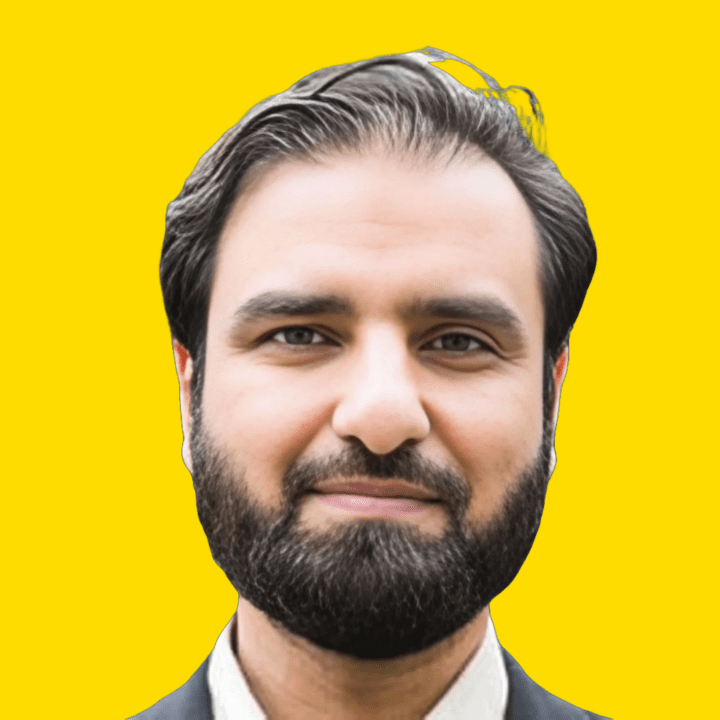


This is the text of a talk delivered at the Ummatics Conference in Istanbul in July 2025.
Introduction
Bismillāh al-Raḥmān al-Raḥīm.
The Ummatics Institute is a think tank dedicated to the unity and reintegration of the Muslim Umma. In the next twenty-five minutes, I will outline how we intend to pursue this goal. In articulating this “ummatic method” or approach, I state our agreed upon beliefs as well as give expression to some unspoken premises and clarify their conceptual linkages.
Let me begin by stating our aspiration, our gold standard: the prophetic method, and what is the way of the prophets? It is most perfectly embodied in the path of the Prophet Muhammad e, who was instructed by Allah,
﴿قُلْ هَٰذِهِ سَبِيلِي أَدْعُو إِلَى اللَّهِ عَلَىٰ بَصِيرَةٍ﴾
“Say: This is my path: I call to Allah with insight, I and those who follow me.” [12:108]
This path requires baṣīra and ḥikma, namely, insight into Allah’s message, wisdom to know your context, trust in Allah’s promise, standing firm, and the inner strength to never abandon your mission.
It is to build—like Nūḥ l—the ark, even if you are mocked and no one sees the coming flood.
It is to stand—like Mūsā l—with the oppressed against Pharaoh’s seemingly irresistible power.
It is to argue—like Ibrāhīm l—with reason and wisdom and to be prepared to sacrifice what is dearest to you for the sake of Allah.
Above all, it means following the final Prophet Muhammad e who trusted Allah completely yet sought every means available. He acquired the knowledge needed to act wisely, consulted his companions, sent out scouts, prayed all night, and planned with extraordinary care. Scholars of the Sīra enumerate up to seventy deliberate steps he took in preparing for the hijra to Madīna, even though he placed his full trust in Allah. To follow him e is to act with vision even amid insult, hostility, and peril; to remain hopeful when others despair. It is to behold, in the sparks from a struck rock while digging a trench under siege, the future submission of Roman and Persian palaces to the truth he bore. It is to dream not according to the limits of your capacity, but in proportion to your hope in Allah.
The prophetic method is not a fixed formula or a set recipe. It is not bound by a number of stages or years. Rather, it is a path shaped by vision—strategic, wise, and deeply aware of context. It allows for disagreement and differences in temperament and approach. Recall how Mūsā rebuked Hārūn l for not stopping his people from worshiping the calf—until Hārūn explained that he feared division and waited for the right moment, choosing unity over immediate confrontation. This path requires patience and perseverance. Nūḥ l preached for nearly a thousand years.
And even as we must strive, we must also pray:
﴿رَبَّنَا وَلَا تَحْمِلْ عَلَيْنَا إِصْرًا كَمَا حَمَلْتَهُ عَلَى الَّذِينَ مِن قَبْلِنَا﴾
“Our Lord, do not place on us a burden like that You placed on those before us.” [2:286]
We begin, then, with a careful reading of our present reality—just as the great revivalists among the ʿulamāʾ shaped their efforts to meet the needs of their time. Some responded to intellectual crises, others to social or political upheavals. Each revival was rooted in the same truth yet adapted to its historical moment. What is the moment that we inhabit?
The Anthropocene
We are living through a moment in history unlike any before, a time of transformations so sweeping they defy categories inherited from past generations. Technological innovation over the past thirty years has outstripped the previous three hundred, and those three hundred already eclipsed the three thousand before them.
Some have called it the Information Revolution that is of the same scale as the Industrial Revolution of the 18th century and the Agricultural Revolution of 10,000 years ago. There have been, of course, other eras of upheaval, but what is unique today is the global simultaneity and connectivity of change. Since the Industrial Revolution, human activity has altered not only the structures of society but the very stage on which the human drama unfolds. What we once called globalization no longer captures the scale or depth of these changes. The digital revolution, artificial intelligence, and the collapse of boundaries between information, work, identity, and power have reshaped the human condition with dizzying speed. Climate change now looms as an existential threat, reshaping ecosystems, fueling wars and migrations, and destabilizing entire societies. A fitting name for this vast convergence of technological, ecological, political, and social upheaval is the Anthropocene—the epoch in which human action has become the dominant force shaping the earth’s climate, environment, and future.
Equally consequential is the rise of extreme inequality in an age of unrestrained capitalism and technological power. Inequality is as old as civilization but never before have a handful of billionaires and political elites wielded such vast, borderless influence—with fortunes surpassing the economies of nations. Traditional structures of religious, cultural, and political authority are crumbling beneath this concentration of wealth and power.
As Muslims, this unfolding reality compels us to ask: what is our responsibility before Allah in this age of the Anthropocene? If humanity has become a force that shapes the planet, then the burden of khilāfa, in the sense of ʿimārat al-arḍ—of stewardship and trusteeship—has never been heavier. We are no longer tasked merely to take the natural and social world for granted but summoned to reach deep into revealed wisdom and effectuate the conditions that enable our divine mandate.
Age of Islamic Revivals
In the Anthropocene, where human powers to alter the conditions of existence reach far beyond previously imagined, secularism has become a seductive paradigm. And yet, despite the strong global trends toward secularization, these profound shifts have not led to the decline of Islam per se.
Consider the following metrics: first, demographics. In 1910, Muslims constituted about 10–13% of the global population—roughly 200 million, out of a total global population just shy of 2 billion. Today, Muslims are approaching 2 billion of the world’s population, projected to be 30% of the total global number by 2050. This is not merely a result of natural population growth. It reflects the remarkable resilience, vitality, and expansion of Islam as a global, lived tradition under profoundly hostile conditions.
Even more striking is the renewed return to Islam among Muslims globally. Despite a century of efforts to secularize Muslim societies—through education, state coercion, media, and economic policy—Islamic practice has not withered. In many regions, especially among youth, religious commitment has deepened. There is a renewed interest in Qurʾanic studies, Islamic law, prophetic ethics, Arabic language, and even premodern Islamic philosophy and theology. Mass movements for ḥijāb, Islamic banking, and sharīʿa-based governance, even if incomplete or contradictory, testify to the success of these Islamic projects.
This success is the outcome of concerted revivalist efforts, in their great variety, much of which may be unacknowledged or unrecorded, that began in the late 19th century. From the various ʿulamāʾ movements and educational institutions to sociopolitical movements, from reformists to conservatives, and more recently, from resistance jihād movements to pan-Islamic statesmen—these trends have laid foundations that have shaped the Muslim world’s religious consciousness and kept Islam alive as a source of private sentiment as well as public meaning.
Downward Spiral of Political Failure
On the other side of this spiritual and intellectual revival lies a painful and undeniable reality: the collective political failure of the Umma—a failure of agency, of world-making, of acting as a unified moral and political subject in history. What we witness today, with deep anguish, is the continued unraveling of the Umma’s political coherence.
Muslims have endured trauma after trauma: colonial conquest followed by native autocrats mimicking colonial rule; mass displacement and forced migrations; economic subjugation and chronic underdevelopment; cultural disintegration and moral confusion—and now, a live-streamed genocide, abetted by the political elites of the neighboring states.
There are two competing narratives about what has gone wrong. One claims that Islam itself in action is the problem—that it dreams of the impossible, refuses to accept the status quo, and fails to acknowledge the total triumph and superiority of the West and its colonial outpost, Israel. It insists on justice, and when that demand is denied, it erupts into anger, unrest, even violence. Any Islamic movement, in this view, is just one step away from militancy. The real crisis, then, is that Muslims refuse to submit. And the solution? To tame them—through authoritarianism, hierarchy, and surrender. A return to jabriyya, the old heresy of fatalism, dressed up as realism.
This is the narrative behind the 2020 Abraham Accords. The so-called “deal of the century.” It is a narrative that demands Muslims submit to their rulers unconditionally. A century ago, Syrian author Abd al-Rahman al-Kawakibi imagined a conference of Muslim thinkers from across the Umma in his fictionalized masterpiece, Umm al-Qurā, and concluded that the greatest cause of our defeat was istibdād, tyranny. Kawakibi’s diagnosis would have been even closer to the mark had he turned to the Qurʾanic word for the same idea. Consider the verse about Pharaoh:
﴿فَاسْتَخَفَّ قَوْمَهُ فَأَطَاعُوهُ ۚ إِنَّهُمْ كَانُوا قَوْمًا فَاسِقِينَ﴾
“He belittled his people, and they obeyed him. They were a wicked people” [43:54]
The term istikhfāf literally means “to take lightly.” If istibdād is to act alone—to rule in isolation, to monopolize decision-making—then istikhfāf is to degrade the people, to insult their intelligence, to manipulate their fears and their loyalties, and to refuse to treat them with dignity, rights, or real concern for their well-being.
We must navigate between two extremes. On one side stands the global Pharaonic order and its local enablers, who claim to fight terrorism while funding, arming, and excusing mass violence. Their masks have slipped. Like Prophet Mūsā l, we too face Pharaohs among us, as well as Qarūns—billionaires who bankroll tyranny and profit from betrayal.
The truth is that the global powers are afraid of the strength of Islam, the vibrancy of Islam that we recounted earlier, and this explains the intensity of repression and breakdown of any remaining international norms and institutions and claims of human rights. The new social contract that the rulers of many of the Muslim states offer their populations, especially since 9/11 and under the dark shadow of the Global War on Terror, is this: that Muslim masses accept life in an open-air prison, as their ruling elites sell off their dreams and riches to colonial powers.
Exclusivism, violence, and extremism are real threats indeed, but the greatest lie that we must confront is that they are the root cause of the problem. Rather, they are only symptoms of the problem of tyranny. Or perhaps a more appropriate medical metaphor is comorbidity. Extremist ideas and sectarianism are comorbidities that have appeared because the Umma has suffered from istikhfāf (indignity). The moral wreckage created by colonialism and its heirs includes a deep internalization of defeat and fragmentation, and some of us have committed the sin of obeying, making it harder and harder for others to resist and change. A Khārijite impulse—zeal without wisdom, piety without principle—continues to fester. It breeds takfīr, sectarian hate, and the rejection of intellectual and spiritual depth. Our task is to diagnose and heal patiently and keep our eyes on the long view.
To sum up, then, both the great revival and the great failure are real, battling each other to the end. The revivalist movements—whether popular Islamic movements, madrasas, universities, or ṭarīqas—urgently need reorientation around an ummatic vision: one that builds rather than reacts, that reintegrates the Umma as a single, interlinked moral and political body.
The Ummatic Method
If we live in the age of information, then the ummatic method must begin by confronting the challenge of information itself—its speed, scale, fragmentation, and power to shape minds and realities.
If we inhabit the Anthropocene—an era defined by unprecedented human impact on the planet’s climate, ecosystems, and built environments—then the ummatic method must reckon with the human capacity to engineer, alter, destroy, control, and build.
In the past, humans lived within their means because resources were scarce, and frugality was a necessity. In the Anthropocene, we must learn to live frugally and humbly by choice. Where earlier societies lived in fear of disease and nature, today, having controlled much of that, many now worship the self, billionaires, or the machinery of organized violence. Who can save us from ourselves? This requires, simply put, superhuman motivation: only discipline revealed by Allah.
Consider, as an example of Islamic civilizational willpower, the question of alcohol. Love of alcohol is virtually universal—from the Irish and Russians to Arabs and Europeans. Its harms are also universally known. And yet, no civilization in history has successfully banned it and sustained a culture of sobriety, except Islam. This is a powerful sign of Islam’s unique potential to meet the challenge presented by the Anthropocene.
The same principle applies in the political sphere: in the past, tyrants were limited by their means, but modern states have vastly expanded their powers of surveillance, propaganda, manipulation, and violent repression. Yet many well-meaning ʿulamāʾ today continue to engage these regimes using medieval methods—private counsel or public denunciation—rather than investing in the creation of robust, independent institutions. Building such institutions is the urgent ummatic task of our time.
This will require us to revisit the Islamic tradition with boldness and care: to pass through it, not around it; to think with it, not merely within it; to remain faithful to its spirit while recognizing that fidelity may now demand forms of reasoning and synthesis that are without precedent. We must treat the past as inspiration, not as a glass ceiling—a foundation to build upon, not a limit to what is possible.
Finally, if this is the age of globalization, then our method must reflect the globality of the Umma. Never before in Islamic history have Muslims been dispersed so widely across the globe. The ummatic method must therefore harness this dispersion not as a weakness but as a strength, as a providential opportunity to connect the Umma across its scattered geographies, and outwardly, to the world beyond, with moral clarity and creative engagement.
In short, the very conditions of our age—the information explosion, the Anthropocene, global dispersal—demand that the method of revival be redefined. It must rise to meet new responsibilities, seize new opportunities, and awaken new capacities. And it must do so not in spite of our tradition, but because of it.
The first axiom of Ummatics, then, is simply this verse:
﴿وَاعْتَصِمُوا بِحَبْلِ اللَّهِ جَمِيعًا وَلَا تَفَرَّقُوا﴾
“Hold on to Allah’s rope together and be not divided.” [3:103]
From this, we derive our unshakable conviction that the effort to unify and integrate—and the variety of efforts that this entails—is inseparable from holding fast to the rope of Allah. One cannot be done without the other. The flourishing of Islam and the unity of Muslims are two sides of the same coin. I have described this elsewhere as ummatic exceptionalism and the prospect of double humiliation.
This leads us to the following five pillars of the Ummatic method.
1. Tarbiya-Taʿāruf
Discovering, nurturing, and mobilizing GEMs
The ummatic method begins by identifying and mobilizing Globally Empowered Muslims (GEMs). As a result of the revivals of the last century and a half, the Umma today holds unprecedented human capital: scholars, entrepreneurs, activists, policymakers, visionaries, and yes, even “influencers.” Ummatics aims to connect and empower these people across borders, not just for individual success, but for coordinated, purposeful action in service of the Umma.
Closely associated with this task of discovering, nurturing, and mobilizing GEMs is the task of discursive integration of the Umma: forging a deeper intellectual and informational unity across the diverse Muslim world. This means recognizing that the divine command to “know one another” (li-taʿārafū) points to a deep, enriching, and transformative function.
Today, we live in an age of immense information flows, yet Muslims in one region often remain unaware of the bodies of knowledge—religious, academic, historical, or strategic—that are shaping thought in other regions. This asymmetry breeds ignorance, which in turn feeds mistrust, alienation, and even sectarianism. Discursive integration responds to this civilizational challenge by fostering among GEMs mutual awareness of our shared resources and challenges. This includes our religious traditions, our scholarly inheritances, our lived experiences, and our hopes. It is only through this mutual knowing that we can develop trust, cooperation, and unified purpose.
2. Wāqiʿiyya-Wasaṭiyya
Drawing critically on existing resources
If we are indeed living in an age of revivals—revivals that have stirred hearts, built institutions, and awakened faith across the Umma, yet often fallen short in addressing deep political, social, and intellectual challenges—then the ummatic method demands that we build upon these efforts rather than dismiss them. The goal is to transform the legacy of revival into a living body of knowledge: to gather its insights, to critique its blind spots, to distill its strengths, and to offer it back to the Umma as strategic guidance. In this way, Ummatics becomes a brain trust for the Umma—not to replace existing projects, but to reinvigorate them, enrich them, and help align their energies with the highest ideals of Islamic vision and civilizational purpose.
These reasons, along with the vast bodies of knowledge available to us, the rich diversity of revivalist efforts, and the absence of unified strategic direction, make the think tank the most effective institutional form for our task.
3. ʿIlm-ʿAmal
Staying close to the trenches
The ummatic method insists that, like our forebears that we seek to emulate, we keep our ear to the ground, close to the trenches, so to speak, where real everyday action takes place, where theory is tested by reality. We resist the temptation of ivory-tower theorizing that remains distant from the lived struggles, hopes, and experiments of Muslim communities. This is why one of our central commitments is to empower action while learning from it, to test our ideas on the ground, improve, and iterate.
Indeed, we believe that good theory is the most practical thing, and yet also, practice often outruns theory. The two must be in conversation. It is in this spirit that we approach sister projects like the upcoming GEM Summit in Doha, as one of many examples of how we learn from practice.
4. Tanawwuʿ-Tadbīr al-Ikhtilāf
Embracing diverse approaches, managing deep differences
The ummatic method does not impose a rigid formula or a universal roadmap for change across the entire Umma. We recognize the vast diversity—geographical, cultural, political, and historical—that defines the global Umma today. Change in Malaysia will not look the same as change in Morocco. What succeeds in Nigeria may not work in Indonesia. In turn, we need to resist ideological rigidity and instead embrace a strategic pluralism of means, attuned to the particularities of context. Our task is to collect knowledge, assess practice, and refine theory continuously.
In some cases, transformation may arise from the top down—through elite reconfigurations or institutional shifts. In others, it may emerge from the grassroots—through popular movements, educational renewal, or community-led reforms. Change may arise as part of a neighborhood effect, like the spread of the Arab uprisings in 2011, or in a myriad other forms.
We recognize the profound diversity within the Umma—across beliefs, ideologies, cultures, languages, and legal schools. These differences, while natural, are often weaponized to sow division and disunity. That is why one of our core commitments is to develop a discourse on managing deep differences. We see this as a vital discipline, one that must be taught in seminaries, schools, and colleges. Muslims must learn to engage historical and doctrinal differences with nuance and honesty—not by denying or romanticizing them, but by acquiring the skills to navigate them with wisdom, even as we seek understanding, unity, and guidance.
5. Muṣābara-Murābaṭa
Preparing for openings
To the question of how we seek to bring about the sweeping changes we envision, our answer draws from the Sīra: like the Prophet e in Makka, we prepare patiently, awaiting divine openings, like Madīna. Social movement theory calls these “political openings”—cracks in elite alliances that appear more often than we think. From the Arab uprisings to significant recent shifts in Bangladesh and Syria, to Gaza’s steadfastness, to the realignment of global powers—each is a moment of opening and potential.
The ummatic method is non-linear by design. It anticipates cycles of progress and setbacks, collapse and renewal. It prepares us for unpredictable moments when new possibilities emerge. For instance, in forthcoming papers on futurology, through both social science and ummatic science fiction—we explore multiple paths forward. Our aim is to reshape the menu of options for those in power, while enabling GEMs to build networks of social, economic, and technological integration.
The ummatic method is not about predicting revolutions but being ready for them. When the doors open, by Allah’s leave, we will be there—with a living method, a united front, and a prepared Umma.
Suggested citation:
Ovamir Anjum, “The Ummatic Method,” Ummatics, Oct 14, 2025, http://ummatics.org/ummatic-method.

Ovamir Anjum
Ovamir Anjum is Chief Research Officer at the Ummatics Institute. He is the author of the article “Who Wants the Caliphate?” published in 2019 at Yaqeen Institute which serves as the provocation for this project. He is professor and endowed chair of Islamic studies in the department of Philosophy and Religious Studies at the University of Toledo, co-editor of the American Journal of Islam and Society (previously known as the American Journal of Islamic Social Sciences), and recently appointed editor-in-chief for the review board the Yaqeen Institute. His areas of research include Islamic history, theology, political thought, and history broadly. His publications include Politics, Law, and Community in Islamic Thought: The Taymiyyan Moment (Cambridge University Press, 2012), and Ranks of Divine Seekers: Translation of Ibn al-Qayyim’s Madarij al-Salikin(Brill, 2020), first two of four volumes. His selected publications can be accessed at https://utoledo.academia.edu/OvamirAnjum