


Abstract
This paper critiques the dominant secular narrative that restricts the origins of global Palestine solidarity to a post-1967 left-wing phenomenon. The author argues that this narrow historical framing oversimplifies a century of Zionist colonization and systematically erases a deep, transnational history of Islamic activism for Palestine. Drawing on extensive historical data—ranging from the interwar anti-colonial movements and mid-century pan-Islamic congresses to the global mobilization of Palestinian student unions—this paper demonstrates that international solidarity with Palestine was operational decades before the 1967 war. At the center of this study is the spiritual, historical, and prophetic significance of Masjid al-Aqṣā (Bayt al-Maqdis), exploring how its faḍāʾil (virtues) have long served as a primary catalyst for the global Muslim Umma. Utilizing frameworks from Critical Muslim Studies and post-colonial theory, the analysis exposes how Eurocentric secular discourses pathologize faith-informed activism, delegitimizing and relocating Muslim solidarity into the suspect register of “Islamization.” This epistemic erasure functions as a disciplinary mechanism that strips Muslim subjects of political agency and forces assimilation into a Westernized liberal order. The paper calls for a decolonial re-evaluation of the Palestinian liberation movement—one that resists secularist gatekeeping, centers the sacred architecture of Al-Aqṣā, and reclaims the vital legitimacy of Muslim agency in the global struggle for justice.
Introduction
Contemporary Western news outlets often treat Palestine solidarity as a recent, 21st-century artifact driven by social media and domestic racial-justice movements.1In contrast, formal academic histories and intellectual political commentary converge on a deeper baseline: that Palestine truly emerged as a global cause only after its adoption by leftists in the wake of the June 1967 Arab-Israeli war.2 Across both the mainstream media’s presentism and academia’s historical periodization, a dominant Western secular narrative prevails. Within this framework, the Palestinian issue is catalogued strictly through the universalist lexicons of human rights, anti-colonialism, anti-apartheid, and international law. The historical and contemporary involvement of the figure of the Muslim in these solidarity strands is systematically disavowed. This erasure of Muslim solidarity does not make Muslim subjects disappear from history, but rather relocates them, transforming faith-centric advocacy into the suspect register of the “Islamization” of an otherwise secular political movement.3
By interrogating these frameworks, this paper challenges both the historical preoccupation with the 1967 baseline and the mainstream media’s presentist amnesia. It points out that isolating global solidarity to these recent historical windows ignores earlier, robust networks of international resistance and obscures a century-long trajectory of Zionist colonization, dispossession, and Palestinian expulsion. At the center of this study is the reclamation of Muslim solidarity with Palestine, a devotion most clearly crystallized by the sacred symbol of Masjid al-Aqṣā. This paper explores the profound spiritual significance of Masjid al-Aqṣā and the enduring Muslim commitment to its sanctuary, demonstrating how this sacred bond has uniquely shaped Muslim perspectives and galvanized transnational support for the Palestinian cause long before the advent of modern secular frameworks.
Consequently, this analysis addresses how Western secular discourses, which project the provincial values of the European Enlightenment as universal ethical standards, misinterpret, devalue, or outright reject political activism informed by Muslim history, the Qurʾan, and the prophetic legacy. It demonstrates how this secularized lens systematically diminishes the deep, ummatic spiritual bond to Masjid al-Aqṣā. By surrendering the history of Palestinian solidarity to an exclusively secular vocabulary, contemporary Western discourses effectively incriminate visible expressions of faith-based resistance. In practice, this serves as an ideological and institutional mechanism designed to discipline, police, and sanitize Muslim subjects within the global public sphere.
Furthermore, the article argues that branding faith-centered activism as the “Islamization” of the Palestinian cause functions as a strategic form of secularist gatekeeping. This pathologization deliberately obstructs meaningful alliances between Muslim communities and broader Western progressive movements by fueling alarmist accusations that the Left is aligning with “extremist forces.” Through this layered historical and theoretical critique, this paper calls for a structural re-evaluation of how activism for Palestine is narrated. It demands a framework that acknowledges the foundational, century-long role of Muslim solidarity shaped by Masjid al-Aqṣā, thereby offering a powerful counternarrative that resists epistemic erasure and asserts the undeniable legitimacy of Muslim agency.
The Secular Eurocentric Palestinian Solidarity Narrative
The prevailing argument suggests that Palestine emerged as a global cause after the June 1967 war, when Israel occupied the West Bank, East Jerusalem, including Masjid al-Aqṣā, Gaza, the Golan Heights in Syria, and the Sinai Peninsula in Egypt.4 As the argument goes, after June 1967, leftists globally became convinced that “Israel was a colonial and violent actor and that Palestine was paramount to the larger battle against colonialism, imperialism, capitalism and U.S. hegemony.”5 Leftist solidarity thus expanded to include hostility to Zionism, sensitivity to human rights, and a Third World anti-colonialist stance.6 However, situating global Palestine solidarity as having begun in 1967 and linking it almost exclusively to the left rests on certain critical assumptions and omissions.
The issue of Palestine in Britain is intertwined with imperialism and, after the Balfour Declaration of 1917, was routinely covered in British media and Parliament. Further, between the interwar years, anti-imperialists, anti-racists and socialists joined with anti-Zionist Jews like Lord Edwin Montagu to highlight the dangers posed by Zionism to Palestine.7 In this milieu, we can locate the establishment of the worldwide League Against Imperialism in 1927. The inaugural conference in Brussels attracted “174 delegates representing thirty-one states, colonies, or regions,” including three from Palestine.8 The League Against Imperialism, active from 1927 to 1937, campaigned to free Palestinians from British imperialist projects and drafted its case in a pamphlet titled “Palestine.”9 Zionist terrorism against the British and indigenous Palestinians after the Second World War was seen as a dangerous escalation and brought a further group of adherents, in particular peace activists, to the Palestinian cause.
Support for Palestine intensified after the Nakba (1947‒48), when the Zionists ethnically cleansed 531 Palestinian towns and expelled 700,000 Palestinians.10 Most of the expelled Palestinians were never allowed to return and became refugees. In exile, Palestinian refugees were motivated to educate their children about the Palestinian cause, who came to play a critical role in galvanizing the global Palestinian movement. Even before the Nakba, Palestinians abroad invested in student activism—as evidenced by the formation of the Palestinian Student Union by approximately 60 Palestinian students at Al-Azhar University in Cairo as early as 1940.11 By 1955, they were admitted to the International Union of Students and in 1958, elected to its Executive Committee.12 As part of the International Union of Students, they gained direct access to students from European-colonized regions who had experience in fighting colonialism.13 In 1959, the Palestinian Student Union formed a transnational body called the General Union of Palestine Students, which in the 1980s had approximately 55,000 active students spread across 55 countries.14 The Palestinian student movement from the 1950s provided a triple platform. It helped organize scattered Palestinians, gave impetus for the emergence of a national liberation movement like the Palestine Liberation Organization (PLO), and galvanized global Palestinian solidarity.15
Ultimately, reducing Palestine’s global prominence to a post-1960s phenomenon relies on a reductive periodization that flattens a century-long history of international solidarity and oversimplifies the complex, diverse coalitions that drove it. As historian Ilan Pappe contends, an obsessive emphasis on the 1967 war inadvertently reinforces a core Zionist myth: the notion that Israel operated as a peaceful, blameless democracy merely defending its borders until that year, a narrative that effectively minimizes its responsibility for the 1948 ethnic cleansing of Palestine.16 In practice, anchoring the crisis exclusively to 1967 functions as a form of “secular-washing” that sanitizes the foundational catastrophe of the Nakba. Furthermore, confining the Palestinian struggle within this secular, Eurocentric timeline forecloses the legitimacy of Muslim intervention. In doing so, it systematically deflects attention from the eternal significance of Masjid al-Aqṣā as a premier symbol of Muslim identity and erases its historical power to mobilize the global Umma. This foreclosure extends what Rashid Khalidi describes as the routine erasure of Palestinian agency from settler-colonial accounts to the broader disavowal of Muslim agency.17
Masjid al-Aqṣā: An Expression of Muslimness
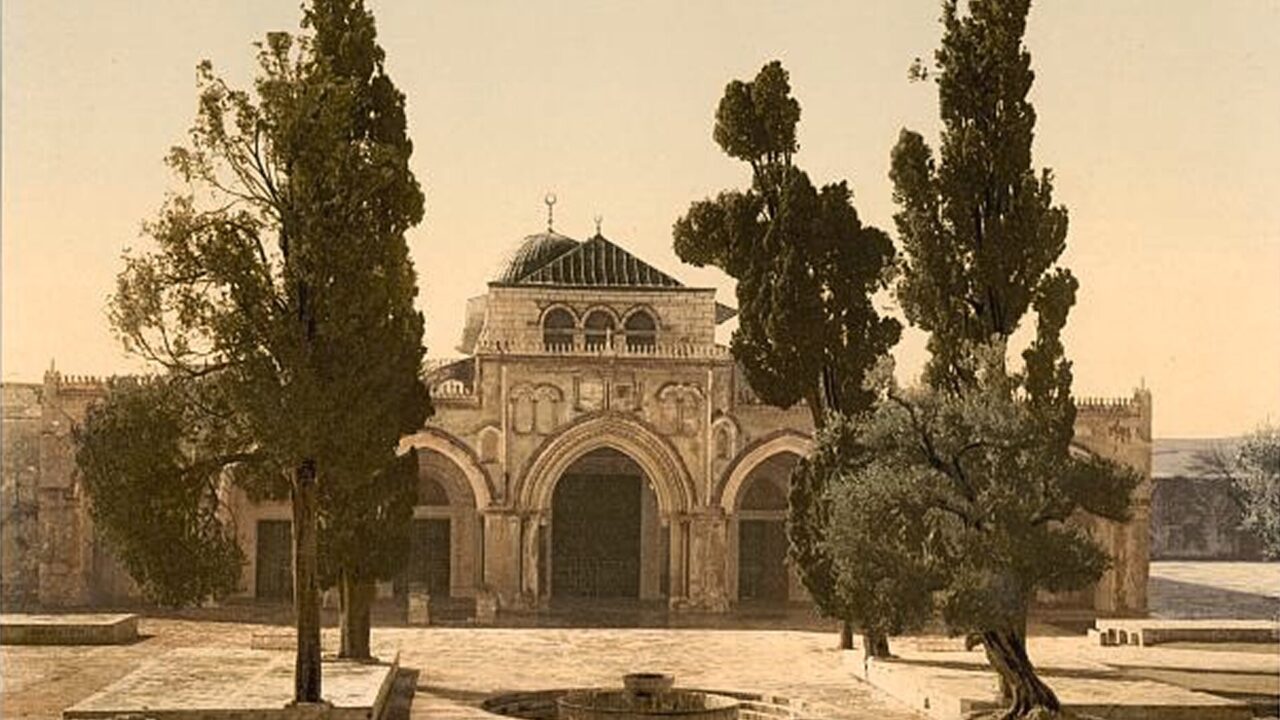
The secular portrayal of the Palestinian cause as primarily leftist reinforces the claim that Jerusalem, whose epicenter is Masjid al-Aqṣā, is “peripheral to Islamic politics, having never been the capital of a major Islamic power, nor the site of a leading institution of Islamic learning.”18 Jerusalem was indeed never the capital of any caliphate, but neither was Makka, the holiest city for Muslims. Even Madīna served as a capital for only the first twenty-four years. There is no inherent connection between a city’s status as a political capital and its sacredness, nor does the absence of such status indicate a lack of “concern.”19 Karen Armstrong demonstrates that Muslim leaders’ appreciation for Jerusalem’s sacred significance across the Abrahamic faiths and their inclusive, pluralistic approach to governance influenced the decision not to establish it as a capital.20 The claim of inclusivity is supported by the leadership of the Caliph ʿUmar f, who brought to an end five centuries of Jewish exclusion from Jerusalem.21 Similarly, after liberating Jerusalem from the Crusaders, Ṣalāḥ ad-Dīn p celebrated the presence of peoples of all faiths. Irrespective of its not being a capital, the significance of Masjid al-Aqṣā remains permanent. Decoupling the figure of the Muslim from Palestinian solidarity not only subverts collective ummatic efforts and responsibility but also undermines the Palestinian liberation movement.
Significance of Masjid al-Aqṣā
From the advent of the Prophet e, Masjid al-Aqṣā emerged as an important signifier. It was the first qibla, and its significance was reflected not only in the physical act of turning towards it in salāt, but also in its profound role in distinguishing the Muslim community within a society where prayers were made before idols surrounding the Kaʿba. As the qibla, Masjid al-Aqṣā helped bring forth a new collective identity. Facing Al-Aqṣā in salāt was a public declaration that one had become Muslim, an action that announced Muslims were dissolving their links with “traditional” Qurayshī paganism and its sociopolitical structures. Masjid al-Aqṣā thus became a marker of Muslimness. Even after the change of the qibla, the centrality of Masjid al-Aqṣā remained uninterrupted.22
The spiritual legacy of Masjid al-Aqṣā—traditionally revered as Bayt al-Maqdis (the House of Purity)—precedes its history as Islam’s first qibla, stretching back to the dawn of humanity when the Prophet Ādam l laid its foundations forty years after the Kaʿba.23 As a primordial source of baraka (divine blessing), the sanctuary holds unparalleled significance in Islamic theology due to its direct connection to 19 of the 25 prophets named in the Qurʾan.24 From the migration of Ibrāhīm and the leadership of Mūsā, to the kingdoms of Dāwūd and Sulaymān, the imamate of Zakariyyā, and the miracles surrounding Maryam, Yaḥyā, and ʿĪsā. In effect, virtually every handspan of Al-Aqṣā is steeped in prophetic footstep or prostration. Frequenting and honoring this sacred land is therefore a profound expression of īmān (faith), validating a Muslim’s cosmic connection to the entire prophetic lineage.
Beyond its historical sanctity, the Prophet e explicitly underscored the virtue of journeying to Masjid al-Aqṣā.25 While such a pilgrimage is not farḍ (obligatory), the established sunna of donning the iḥrām for Ḥajj or ʿUmra at Al-Aqṣā uniquely fuses this sanctuary with an obligatory pillar of Islam.26 This deliberate connection weaves Al-Aqṣā directly into the foundational devotional repertoire of the global Umma. Ultimately, visiting the sanctuary is transformed from a mere physical journey into a vital spiritual discipline that purifies the soul, revives personal faith, and reinforces a deep sense of transnational ummatic belonging.
The Sunna further interweaves and fuses Masjid al-Aqṣā with the Qurʾanic command of charity.27 A ḥadīth makes an incredible equivalence between those who send oil to light the lamps of Masjid al-Aqṣā and those who actually perform salāt within it, granting both the same reward.28 The sending of oil is metaphorical, as during the time of the Prophet e there was no prayer hall within Masjid al-Aqṣā, nor were there Muslims residing in Bayt al-Maqdis. The oil ‘providing light’ thus points not only to literal illumination, but also to the establishment of symbolic light (nūr), through the remembrance of Allah Z, dhikr, and salāt. Both spiritual illumination and literal light are made possible through charitable support for the upkeep of Masjid al-Aqṣā, which complements the initial sacrifice made for its liberation and continued need for its defense.
Moreover, the reward for one salāt in Masjid al-Aqṣā is 500 times greater than in any other masjid besides the two sanctuaries in Makka and Madīna.29 Further, the Night Journey (al-Isrāʾ) of the Prophet e narrated in the Qurʾan became etched eternally into Muslim consciousness, making Masjid al-Aqṣā an integral part of faith. The Night Journey establishes an epistemological and spiritual connection between al-Muqaddas (the Holy Prophet e), who was taken in the company of Rūḥ al-Qudus (the angel Jibrīl l) via al-Arḍ al-Muqaddasa (Al-Aqṣā) to al-Quddūs (Allah Z).30
Remarkably, the Prophet Muḥammad e gave the glad tidings of Jerusalem’s liberation at a time when the Muslims’ own survival appeared to be in doubt.31 He e also directed Shaddād ibn Aws f and other ṣaḥāba h to migrate there.32 Masjid al-Aqṣā will also hold particular significance at the end of time. The appearance of Dajjāl (the Deceiver), the presence of the Mahdī in al-Shām, the return of ʿĪsā l, the killing of Dajjāl by ʿĪsā l in Ludd, the Trumpet blast to end this world, and many other events will be centered around Bayt al-Maqdis.33 These eschatological narratives are presented here as part of the symbolic vocabulary through which the Umma has historically related to Bayt al-Maqdis, not as predictive claims to be adjudicated by historical method.
Masjid al-Aqṣā: Muslim commitment
Through these factors and others, Masjid al-Aqṣā became an inseparable part of Islam, attracting thousands of the Prophet’s Companions h to volunteer in its liberation, with some opting thereafter to reside in its environs. Thereafter, successive caliphates and sultanates made significant contributions to Masjid al-Aqṣā. The Umayyads (661–750) funded its development. ʿAbd al-Malik ibn Marwān commissioned the Qubbat al-Ṣakhra (Dome of the Rock) in 72–73/691–692, while his son al-Walīd (r. 705–715) expanded and renovated the wooden Muṣallā (prayer hall) of Al-Aqṣā built by the Caliph ʿUmar f. The Abbasids established educational institutions and libraries, making Masjid al-Aqṣā an important center of Islamic scholarship and learning. After liberating Masjid al-Aqṣā from the Crusaders, the Ayyubids restored it to its former glory. The Mamluks (1250‒1517) financed the maintenance, beautification, and further development of the compound. Masjid al-Aqṣā experienced a new architectural and intellectual resurgence with Ottoman rule (1517‒1922). Throughout the Ottoman period, the presence of Sufis in Bayt al-Maqdis remained as intense as ever. The Turkish traveler Evliya Çelebi (d. 1090/1679) wrote that in Bayt al-Maqdis, there were 240 miḥrābs, seven ḥadīth schools, ten Qurʾanic schools, forty boys’ schools and seventy zāwiyas.34 He further observed that there were 800 salaried staff at Masjid al-Aqṣā.35
In the intervening period across various caliphates, the scholars and sufis invested in extolling the virtues of Masjid al-Aqṣā.36 Some sufis travelled from as far as Indonesia, Africa, and Bosnia, making Jerusalem their home. Rābiʿa al-Baṣriyya s spent considerable time teaching at Bayt al-Maqdis. Ibrāhīm ibn Adham p made Masjid al-Aqṣā’s walls his night pillow. Imām Ghazālī p spent up to 10 years within Masjid al-Aqṣā.37 Masjid al-Aqṣā attracted people like Shaykh Farīd al-Dīn Ganj Shakar, or Baba Farīd p, who inspired Muslims from the East (present-day Afghanistan, Pakistan, India and Bangladesh) to follow in his footsteps. Many of these Muslims came to Masjid al-Aqṣā, adorned their iḥrām for Ḥajj or ʿUmra and then proceeded to Makka, further ingraining Masjid al-Aqṣā in the Umma’s consciousness.
Masjid al-Aqṣā: symbol of solidarity
As a signifier of Muslimness, Masjid al-Aqṣā inspires and mobilizes the Umma to protect, preserve, and defend the land and its people. ʿUmar f, the second caliph, refused to leave Madīna because he desired to be buried there, but, appreciating the virtues of Masjid al-Aqṣā, he made an exception to travel and receive the keys of Jerusalem. Nūr ad-Dīn Zengī (d. 1174) committed his resources and galvanized Muslims against the Crusaders. He commissioned a pulpit to be placed in Masjid al-Aqṣā upon its liberation. As the seat of religious and political leadership, the minbar symbolized authority and dignity; its absence from Masjid al-Aqṣā signified a loss of authority, respect, and leadership in the temporal realm, and a weakening of īmān in the sacred sphere. The message was clear: honor, dignity, and faith are intertwined with Masjid al-Aqṣā, and striving for its liberation is an obligation, not a choice.
To galvanize the Umma against the Crusaders, both Nūr ad-Dīn and Ṣalāḥ ad-Dīn (d. 1193) promoted and commissioned treatises on Faḍāʾil al-Quds (Virtues of al-Quds) to be read in masājid across territories under their control. The works of Abū al-Qāsim al-Rumaylī (d. 1099), Abū Bakr al-Wāsiṭī (d. after 1019), Abū al-Maʿālī al-Maqdisī (d. after 1047) and ibn ʿAsākir (d. 1176) became famous, motivating thousands to join Ṣalāḥ ad-Dīn for jihād.38 Other scholars consider Muslim unification and volunteering for jihād against the Crusaders as having been “focused on the sanctity of Palestine and more especially of Jerusalem.”39 Similarly, the Mamluks highlighted the dangers posed to Masjid al-Aqṣā by the Mongols, thereby committing Muslims to the battlefield.
In more recent colonial history, the Hussein-McMahon Correspondence shows how the British coaxed Muslim Arab allegiance against the Ottoman Caliphate by framing their appeal through the promise of an independent Palestine—understood as a free Masjid al-Aqṣā.40 Even the last Ottoman caliph, ʿAbd al-Ḥamīd II, despite economic pressure, declined Theodor Herzl’s offer of two million pounds to facilitate the Zionist colonization of Jerusalem.41 ʿAbd al-Ḥamīd, in the words of Herzl, declared that “he could never part with Jerusalem. The Mosque of Omar must always remain in the possession of Islam.”42
After the British colonization of Jerusalem and the Zionist infiltration, Masjid al-Aqṣā remained a rallying symbol. A major conference organized by Ḥājj Amīn al-Ḥusaynī, the leader of Mandatory Palestine, was held in Jerusalem in December 1931 attended by 250 delegates from 22 Muslim-majority countries. After two weeks of debate, the issue of Masjid al-Aqṣā emerged as paramount, and the resolution emphasized that the Burāq Wall (the Western Wall) is “sacred to Muslims” and “Palestine is important to all the World of Islam.”43 Influential figures from pre-partition India were present, including Muḥammad Iqbāl and Shawkat ʿAlī.44The Indian Muslim interest in Palestine preceded the 1931 Conference. While the interest of colonized Muslims in India was entangled with the Ottoman Caliphate, it was couched in the language of advancing and preserving “Muslim religious and cultural institutions,” particularly Masjid al-Aqṣā.45 A delegation from Palestine arrived in India in 1923‒24 to highlight the threats posed by British colonization and the empowerment of Zionists, especially the dangers posed to Masjid al-Aqṣā. Funds of around £25,000, equivalent to approximately £1.9 million today, were collected, raising fears in the British Colonial Office of “an intense Pan-Islamic response” to British colonialist ambitions.46
While Ḥājj Amīn focused on conferences, protests, and strikes, the Syrian Shaykh ʿIzz al-Dīn al-Qassām (1881–1935) pioneered a military strategy against British colonial rule and Zionist expansion.47 As an imām, he mobilized large numbers of Muslims, leading them throughout the 1930s in attacks against British and Zionist targets until he was killed in a standoff with British forces in 1935. The Palestinian cause, along with the sanctity of al-Aqṣā, also resonated in the teachings of Egyptian scholar Ḥasan al-Bannāʾ (1906–1949), founder of the Muslim Brotherhood.48 Nations emerging from European colonialism, such as Malaysia, which gained independence in 1957, soon made support for Palestine a cornerstone of their foreign policy.49
The 1969 arson attack on al-Aqṣā, following Israel’s occupation in 1967, devastated the southern part of the Qiblī Muṣallā and destroyed Nūr ad-Dīn’s minbar. The shock of this violation spurred leaders from twenty-five Muslim-majority countries to convene a conference that eventually led to the establishment of the Organization of the Islamic Conference (OIC).50 Meanwhile, street-level reactions from Indonesia to Morocco were more immediate and impassioned, with protestors in some capitals calling for jihād.51
The Palestinian issue has attracted liberation movements and activists from Oman, Bangladesh, South Africa, Yemen, and even the Black Panthers in the United States, some of whom received military training or fought alongside the PLO in Lebanon.52 In this broader ummatic context, world boxing champion Muhammad Ali’s 1974 visit to Beirut, where he was accompanied by Palestinian fighters, was emblematic; he declared, “In my name, and in the name of all Muslims in America, I declare support for the Palestinian struggle to liberate their homeland and oust the Zionist invaders.”53
In 1980s South Africa, Muslim anti-apartheid campaigners aligned with the Palestinian cause through the Muslim Youth Movement (MYM) and the Muslim Students Association (MSA), rallying under the slogan “Free al-Aqṣā.”54 In Turkey, from the 1980s onward, parties such as the National Salvation Party and the Welfare Party bolstered their Islamic credentials by organizing demonstrations and events highlighting the significance of Jerusalem.55 In the West, American Muslims for Palestine (AMP), founded in 2006, began hosting annual conventions that attract thousands, boldly articulating Palestinian solidarity through the lens of al-Aqṣā.56 Across the ocean in the UK, Friends of Al-Aqsa, established earlier in 1997, held its first international conference in 1998 under the title The Centrality of Al-Aqṣā in Islam and launched a journal named Al-Aqṣā.57 More recently, the 2017 launch of Aqsa Week has expanded this network, with organizations from over 50 countries participating and promoting solidarity with Palestine through Faḍāʾil al-Aqṣā.58
Despite the apathy and negligence of many political leaders in Muslim-majority countries, the global Muslim community continues to rally behind Palestine with unwavering support. Across continents, millions of Muslims actively organize and participate in protests. Motivated by their love for al-Aqṣā, Muslims have also consistently surpassed expectations in fundraising efforts and donations for Palestine. Harnessing the power of social media, Muslims worldwide amplify Palestinian voices and counter misinformation. In the 2024 UK general elections, Muslim voters were credited with helping secure the victory of five pro-Palestinian independent MPs and contributing to a shift away from the Labour Party’s traditional support, as Labour was perceived as pro-Israel under Keir Starmer’s leadership.59 Muslims also lead cultural, educational, sports, and economic boycotts, delivering significant financial blows to pro-Israel companies. Independent masājid where the Friday khuṭba does not include supplications for Masjid al-Aqṣā are few and far between. This collective determination, driven by faith, compassion, and justice, keeps the Palestinian cause firmly at the forefront of global discussions.
The deep cultural fabric of Palestinian solidarity symbolized through Masjid al-Aqṣā is also reflected in stamps and currency notes depicting the Dome of the Rock in countries like Iran, Iraq, Mauritania, Malaysia and Indonesia, among others. Masjid al-Aqṣā or its derivative globally finds its way into the names of schools, civil society organizations, media outlets, masājid and NGOs. Al-Aqṣā is designated to major Palestinian events like the Al-Aqṣā Intifada in the early 2000s, Al-Aqṣā Storm in 2023, and military groups like the Al-Aqṣā Martyrs Brigade. National and international conferences highlighting the Palestinian cause regularly have “Al-Aqṣā” in their title.
Muslims have consistently demonstrated an earnest and unwavering devotion to Masjid al-Aqṣā, recognizing it as a sacred site of immense spiritual and historical significance. Their reverence for al-Aqṣā has driven concrete efforts to uphold its sanctity, preserve its structure, and safeguard its rich heritage. This commitment is reflected in centuries of financial investment, architectural restoration, and cultural initiative. Moreover, Muslims have sacrificed time, resources, and even their lives to defend al-Aqṣā against threats to its integrity and sanctity. This enduring dedication underscores the central role of al-Aqṣā as a unifying force in the Umma and a symbol of spiritual resilience and faith.
Erasure and Relocation
Deconstructing the secularist framework of Palestine solidarity requires unpacking its dual ideological mechanisms: erasure and relocation. The systematic omission of the Muslim subject feeds Orientalist narratives that deny Muslim historicity and strip faith-based actors of political agency. Conceptually, erasure suppresses Muslim figures, motivations, and vocabularies from the historical record—manifested in the glaring absence of Masjid al-Aqṣā, the Caliphate, and Islamic juristic discourse from mainstream historiography. Conversely, when Muslim mobilization is too prominent to ignore, relocation reclassifies it as “Islamization” or “religious extremism,” effectively quarantining faith-based advocacy from legitimate political solidarity.
Both operations yield verifiable empirical indicators: erasure can be tracked by the scarcity of Islamic terms and actors in solidarity literature, while relocation is signaled by the co-occurrence of “Islamization” frames with securitized, counter-extremism vocabularies in media and policy texts. While this paper provides a qualitative synthesis of these dynamics, a computational framing analysis along these lines offers a natural empirical extension to this critique. Locating Muslim activism within a secular framework surrenders to Western ideological assumptions, particularly the presupposition of religion as an oppressive institution and the insistence upon a strict formal separation between religion and politics. These concessions are not benign but rather perpetuate Eurocentrism, which seeks to discipline the figure of the Muslim and reframe Muslimness within a Western gaze.
The history of Western and Westernized political structures reveals a deep hypocrisy: the putatively absolute separation between religion and politics is routinely bypassed by state-sanctioned exceptions.60 Historically, secular British imperialists readily weaponized Christianity to justify colonization and chattel slavery. In the modern era, this selective application is evident in secular India, where the demolition of the Babri Masjid was state-sanctioned “entirely as a matter of [Hindu] faith.”61 This contradiction is most glaringly manifest in the colonization of Palestine. Despite its secular veneer, the Zionist project relies heavily on theological justifications; Benjamin Netanyahu explicitly invoked biblical narratives at the United Nations to declare that the Jewish people are not occupiers in their own land.62 Today, secular Israeli ministers openly support approximately twenty religious Temple Mount groups actively preparing for the demolition of Masjid al-Aqṣā,63 while a broader alliance between secular and Christian Zionists weaponizes biblical rhetoric, such as the narrative of Amalek, to legitimize ethnic cleansing and genocide in Gaza.64 Ultimately, the absolute separation of religion from politics is a selective fiction, weaponized to accommodate dominant state nationalisms while systematically policing non-Western faiths.
To submerge or subordinate Muslim solidarity within allied leftist politics to appease secular sensibilities is to sacrifice the guidance of the Qurʾan and Prophet’s teachings as the raison d’être for solidarity. Such capitulation would render solidarity with the Palestinian cause the preserve of Western secularism, feeding the Eurocentric myth that the only acceptable reasons for solidarity are rooted in secular values, directed by secular agents, and performed only along secular lines. It is to concede the inadmissibility of the sacred (Islam) as a valid basis for ethical conduct in the world and to support the instrumentalization of the figure of the Muslim “as a negation of an idealized Western secular self”65 or an antithesis of “a marker of Western identity.”66
The erasure of Muslimness in Palestinian solidarity denies the spiritual and transcendental dimensions that have historically motivated Muslims. By subordinating Muslim activism to a secular paradigm, the discourse disparages Masjid al-Aqṣā, stripping it of its profound spiritual and ummatic bond and its transnational resonance. In this sense, secularism becomes a tool in the hands of the state for the disciplining of Muslim causes and values. Such discipline is conducted through surveillance, normalization, and examination.67 Where Muslimness is construed as a contagion infecting Western social and political bodies, it is rendered justifiably subject to surveillance. The intrusive mass surveillance ubiquitous today primarily targets Muslims and effectively puts all Muslims under suspicion.68 Finally, examination fuses surveillance and normalization, through which Muslimness is cast under the torchlight of the Western gaze.69 Every symbol, action, utterance, and note gets classified and judged as interrupting Westernese, the discourse of Western supremacy that casts the West as the author of human progress and Western values as the sole universal.70 The result is that actions such as invoking the takbīr, wearing the kūfiyya, flying the Palestinian flag, commemorating Palestinians killed as shuhadāʾ, and even reminding of the faḍāʾil of Masjid al-Aqṣā are cast as disrupting secular norms.
According to Sharmin Sadequee, discipline is an “instrument to revise and alter modes of non-Western moral and ethical life and to render human subjects more suitable for assimilation into the burgeoning secular/liberal world order, including its concept of appropriate religion.”71 It is, in a word, “violence.” It is violence because disciplining detaches Muslims from the Islamicate and strips them of their dignity—the inalienable right to express their heritage, informed by the Qurʾan and Seerah, without being marginalized or policed. In this context, secularism is re-asserted and re-promoted as a means of disciplining the articulation of Muslim identity.72
The more Muslims surrender to the forces of secularism, the more they become subject to its violence. The logical conclusion of such concessions is to cast Muslimness as a pathology that requires remedy through assimilation into Westernese. Hence, surrendering political activism informed by Masjid al-Aqṣā to secularist demands effectively renders the land blessed by Allah irrelevant and inapplicable as a basis for solidarity. Moreover, submitting to secularist demands reinforces the toxification of Muslimness. The challenge for Muslims is to interrupt the secularist narrative that constructs “the Rest”, including Muslims, as existing outside of the normative. Centering the faḍāʾil of Masjid al-Aqṣā within Palestinian solidarity activism offers a powerful counternarrative to the Eurocentric underpinnings of secularism, challenging the Western monopoly on framing legitimate causes of solidarity and contributing to a broader political struggle that destabilizes exclusivist claims over narratives of resistance.73
The secularist relocation of Muslim solidarity to the register of “Islamization” nourishes a broader Eurocentric prejudice that constructs Islam as a counter-image to the West. This narrative casts Islam as inherently anti-modern, anti-secular, and incompatible with the principles of Western civilization. In doing so, it performs multiple strategic functions. Casting the Palestinian cause as one that has been subjected to “Islamization” enables Western elites to paint global Muslim solidarity with Palestine in an ominous light, presenting it as adjacent to, if not outright shot through with, militancy, extremism, and terrorism.74 This opens the possibility of casting leftist alliances with Muslims as an extension of an “Islamist agenda,” allowing leftist solidarity with Palestine to be dismissed as naïve, with leftists in alliance with Muslims pathologized as “terrorists’ useful idiots”75 and as part of a dangerous “Red-Green” coalition that poses a significant threat to Western stability, warranting “careful attention from U.S. and European policymakers.”76
Netanyahu has capitalized on such alarmist framings, characterizing worldwide Muslim solidarity with Palestinian rights as a global “Islamic threat.” After the 2015 Paris attacks, he drew direct parallels between attacks on Western cities and Palestinian solidarity, promoting Israel as the front line in the global fight against Islamic extremism.77 The depiction of Zionists as a bulwark of Western civilization against barbarism is a hallmark of Zionism and dates back to the founder of political Zionism, Theodor Herzl.78 This conflation of Palestinian resistance with terrorism as a global threat delegitimizes Muslim solidarity and draws it into the orbit of extremism and violence, thus embedding Islam and Muslimness within the “politics of risks.”79 Muslimness becomes subject to intrusive monitoring and institutionalized discrimination within the broader enterprise of Islamophobia.
The toxification of Masjid al-Aqṣā as a valid symbol of Muslimness obstructs the forging of a link in the chain of solidarity with leftist and other progressive activists. Secularism, in this context, is mobilized as an ideological tool that validates the exclusion of Islam from both the political discourse and the cultural life of Western nations. As Modood observes, “secularism is re-asserted as an ideological force to oppose Islam and its public recognition.”80 By casting Muslimness as an inherent “other,” secularist discourses exceptionalize Western signifiers as the sole indicators of inclusivity and tolerance while simultaneously painting Islam as discriminatory and intolerant. In this way, the racialization of Muslim solidarity as “Islamization” provides secularists with the perceived moral authority to speak in the name of universalism, even as they exclude Muslim contributions to global Palestinian movements for justice. Moreover, the erasure of Muslims from the Palestinian solidarity narrative not only silences diverse voices within activist circles but also reinforces a self-serving myth of Western inclusivity. By projecting only Western-centric signifiers as valid, secularist discourse perpetuates a binary in which the West is seen as inherently progressive and Muslims as perpetually at odds with modern values. This dichotomy undermines the legitimacy of Muslim political engagement and stifles the broader potential for coalition-building among diverse groups committed to justice for the Palestinians.
The argument of this paper is that solidarity discourse must accommodate plural ethical vocabularies, including those grounded in Islamic juristic and prophetic traditions. Three commitments follow. First, coalition spaces—student movements, trades unions, faith fora, civil-society networks—should recognize Masjid al-Aqṣā as a legitimate ethical-political anchor alongside human-rights, anti-colonial, and international-law frames. Second, media and policy interlocutors should retire the “Islamization” frame and engage Muslim civil society on its own terms. Third, the academic historiography of Palestine solidarity should broaden its archive to include Muslim periodicals, fatāwā, conference proceedings, and the records of organizations such as the OIC, Friends of Al-Aqsa, and American Muslims for Palestine. Adopting these commitments does not require non-Muslim allies to share Muslim theological premises; it requires recognizing that ethical pluralism is the precondition of any solidarity that aspires to be both decolonial and durable.
Conclusion
Chronologically anchoring global Palestinian solidarity exclusively to the post-1967 era is fundamentally reductionist. This narrow periodization obscures a century of Zionist colonization and erases the enduring, pivotal role of Muslim mobilization centered around Masjid al-Aqṣā. Subordinating this resistance to Western secular paradigms forces an epistemic detachment from Islamic spiritual, cultural, and historical heritage. This coerced detachment constitutes a form of structural violence: it hollows out Muslim identity and denies faith-based actors the right to define their own terms of resistance and articulate an alternative worldview.
By centering the faḍāʾil (virtues) of Masjid al-Aqṣā as a shared heritage, Muslim solidarity transcends the artificial boundaries of modern nationalism and secularism, fostering a robust vision of transnational, ummatic unity for justice. Advancing these faith-based contributions directly disrupts the secular solidarity narrative’s claim to ethical universality. This intervention exposes the systemic hypocrisies of Eurocentric discourse, subverts the pathologization of Muslimness, and counters the tropes driving contemporary Islamophobia. Crucially, reclaiming the sanctity of Al-Aqṣā safeguards Islamicate memory and knowledge from institutional policing, ensuring the transmission of these traditions across generations and protecting cultural identity from erosion.
Ultimately, untangling secularism from Palestinian solidarity is a critical step toward constructing alternative historiographies that challenge dominant Eurocentric paradigms of resistance. Foregrounding Masjid al-Aqṣā is not merely an additive historical exercise; it is a direct challenge to the intellectual and political structures that perpetuate Western hegemony. By resisting epistemic erasure, this intervention asserts a more authentic, inclusive framework for global activism, contributing to the broader struggle to decolonize “the Rest,” restore historical dignity, and reclaim autonomous Muslim agency.
* * *
Suggested Citation:
Ismail Adam Patel, “Beyond the Secular Gaze: Masjid al-Aqṣā, Muslim Agency, and the Decolonization of Palestine Solidarity,” Ummatics, June 15, 2026, http://ummatics.org/secular-gaze.

Ismail Adam Patel
Ismail Adam Patel is the founder of the UK-based NGO, Friends of Al-Aqṣā, and former visiting research fellow at the University of Leeds. He is a leading voice on Palestinian liberation and pivotal in mobilizing civil society. His works include A Brief History of Palestine(Al-Aqsa Publishers, 2023), Madīna to Jerusalem: Encounters with the Byzantine Empire(Kube Publications, 2005), The Muslim Problem: From British Empire to Islamophobia,andTreasures of the Holy Sanctuary(Al-Aqsa Publishers, forthcoming). He is committed to exploring decolonial thought and advancing Critical Muslim Studies.
Notes
- For examples, see Charlotte Alter, “How the Activist Left Turned on Israel,” Time, October 14, 2023, https://time.com/6323730/hamas-attack-left-response/; and Ross Barkan, “The Pro-Palestinian Left is Booming,” New York Intelligencer, November 30, 2023, https://nymag.com/intelligencer/2023/11/the-anti-israel-pro-palestinian-left-is-booming.html. Even left-wing historical self-assessments often trace the massive growth of the contemporary grassroots Western movement to the late 2000s rather than the 1960s; see: Editorial, “Palestine and the Left,” Jacobin, April 21, 2013, https://jacobin.com/2013/04/palestine-and-the-left.
- See Sune Haugbolle and Pelle Valentin Olsen, “Emergence of Palestine as a Global Cause,” Middle East Critique 32, no. 1 (2023): 129–148; William Eichler, “Singling out Israel: A Perspective From the Left,” OpenDemocracy, June 2, 2015, https://www.opendemocracy.net/en/north-africa-west-asia/singling-out-israel-perspective-from-left/; and James Meade Klingensmith, “Partitioning Solidarity: Palestine and the British left 1923–48,” PhD diss., (Stanford University, 2022), 7, ProQuest (29755907), which outlines the historiographical consensus regarding the post-1967 left-wing “divorce” from Zionism.
- See, for example, Meir Litvak, “The Islamization of the Palestinian-Israeli Conflict: The case of Hamas,” Middle Eastern Studies 34, no. 1 (1998): 148–163. For a historical analysis of how secular leftist factions were eclipsed and marginalized on the ground during the rise of these religious frameworks, see: Francesco Saverio Leopardi, “The Popular Front for the Liberation of Palestine during the First Intifada: From Opportunity to Marginalization (1987–1990),” British Journal of Middle Eastern Studies 44, no. 2 (2017): 268–282.
- Haugbolle and Olsen, “Emergence of Palestine as a Global Cause,” 130.
- Sorcha Thomson and Pelle Valentin Olsen, eds., Palestine in the World: International Solidarity with the Palestinian Liberation Movement (London: I.B. Tauris, 2023), 3.
- See Colin Shindler, Israel and the European Left: Between Solidarity and Delegitimization (New York: Continuum, 2012), 247, 274; Shadi Abu-Ayyash, “The Palestine Solidarity Movement, Human Rights and Twitter,” Networking Knowledge 8, no. 2 (2015): 1-18. See also: The Left in the European Parliament. Our Solidarity with the Palestinian People. The Left in the European Parliament, November 27, 2020, https://left.eu/imagine-annexation/; and Thomson and Olsen, eds., Palestine in the World, 72.
- Ismail Adam Patel, A Brief History of Palestine (UK: Al-Aqsa Publishers, 2023), 84.
- Michele Louro, Carolien Stolte, Heather Streets-Salter, and Sana Tannoury-Karam, eds., The League Against Imperialism: Lives and Afterlives (Leiden: Leiden University Press, 2020), 17.
- League Against Imperialism, Palestine (London: International Secretariat of the League Against Imperialism and for National Independence, 1936).
- Patel, A Brief History of Palestine, 127.
- Saliem Wakeem Shehadeh, “Researching the General Union of Palestine Students from the Diaspora,” PhD diss., (University of California, Los Angeles, 2023), 104.
- Ido Zelkovitz, Students and Resistance in Palestine: Books, Guns and Politics (London and New York: Routledge, 2015), 18.
- Mjriam Abu Samra, “The Palestinian Transnational Student Movement 1948-1982: a Study on Popular Organization and Transnational Mobilization.” PhD thesis, University of Oxford, 2020, 71.
- Shehadeh, “Researching the General Union of Palestine Students from the Diaspora,” 1.
- Abu Samra, “The Palestinian Transnational Student Movement 1948–1982,” 103-104.
- Ilan Pappe, “A Journey to June 1967 and Back: On the Fabricated Narratives of Zionism,” The Palestine Chronicle, June 14, 2022, https://www.palestinechronicle.com/a-journey-to-june-1967-and-back-on-the-fabricated-narratives-of-zionism/.
- Rashid Khalidi, The Hundred Years’ War on Palestine (London: Profile Books, 2020), 31.
- Nicholas E. Roberts, “Making Jerusalem the Centre of the Muslim World: Pan-Islam and the World Islamic Congress of 1931,” Contemporary Levant 4, no. 1 (2019): 54.
- Roberts, “Making Jerusalem the Centre of the Muslim World,” 54.
- Karen Armstrong, “Sacred Space: The Holiness of Islamic Jerusalem,” Journal of Islamic Jerusalem Studies, 1, no. 1 (1997): 5–20.
- Ismail Adam Patel, Madina to Jerusalem: Encounters with the Byzantine Empire (Leicester: Kube Publications, 2005), 94.
- Qurʾan, al-Baqara 2:143–145.
- Ṣaḥīḥ al-Bukhārī, 3366.
- Ṣaḥīḥ Muslim, 8a.
- Ṣaḥīḥ Muslim, 1397a.
- Sunan Abu Dāwūd, 1741.
- See: Qurʾan, al-Baqarah, 2: 43; 215; 271 and al-Ḥadīd, 57:11.
- Musnad Ahmad, 27626; Sunan Abu Dāwūd, 457.
- Mustadrak of Imām Ḥākim, #8553; graded ṣaḥīḥ (Imām Dhahabī has corroborated this).
- An-Nuwayrī, Nihayatul Arab fī Funūnil Adab, (Cairo: Dār al-Kutub al-Miṣriyya, 1955) 16:78; also see al-Maqdisī, al-Mawāhib al-Ladunniyya.
- Ṣaḥīḥ al-Bukhārī, 3176.
- Ṭabarānī, al-Kabīr (Cairo: Maktabat Ibn Taymiyyah, 1994) 7:289; Sunan Abū Dāwūd, 2482.
- Ismail Adam Patel, Masjid Al-Aqṣā: Treasures of the Holy Sanctuary, (UK: Al-Aqsa Publishers, forthcoming).
- Robert Dankoff and Sooyong Kim, An Ottoman Traveller: Selections from the Book of Travels of Evliya Çelebi, (London: Eland Publishing, 2011), 318.
- Dankoff and Kim, An Ottoman Traveller: Selections from the Book of Travels of Evliya Çelebi, 313.
- Those who frequented Masjid Al-Aqṣā include: Sufyān al-Thawrī (d. 161/778), Fuḍayl ibn ʿIyāḍ (d. 178/803), Saʿīd ibn al-Musayyab (d. 94/713), Muḥammad ibn Idrīs al-Shāfiʿī (d. 204/819), Dhū an-Nūn al-Miṣrī (d. 245/859), Saʿīd al-Afrīqī (second century Hijri), Ṣāliḥ ibn Yusuf (d. 282/895), Muḥammad ibn Karrām (d. 255/869), Abd al-Wāḥid Muḥammad al-Shirāzī al-Hanbalī (d. 486/1093), Abū al-Fatḥ Naṣr Ibrāhīm al-Maqdisī (d. 490/1097), and many others.
- While in the Sanctuary of Al-Aqṣā, Imām Ghazālī wrote al-Qisṭās (Just Balance), Maḥakk an-Naẓar (Touchstone of Reasoning in Logic), and part of his famous treatise Iḥyāʾ Ulūm ad-Dīn (The Revival of the Religious Sciences).
- Full Names: Abū al-Qāsim Makkī ibn ʿAbd as-Salām al-Rumaylī (d. 1099), Abū Bakr Muḥammad ibn Aḥmad al-Wāsiṭī (d. after 1019), Abū al-Maʿālī al-Musharraf ibn al-Murajjā ibn Ibrāhīm al-Maqdisī (d. after 1047) and Thiqat ad-Dīn ibn ʿAsākir (d. 1176); See: Suleiman A. Mourad, “The Faḍāʾil of Jerusalem Books as Anthologies,” in: Bilal Orfali and Nadia Maria El Cheikh (eds.), Approaches to the Study of Pre-Modern Arabic Anthologies (Leiden: Brill, 2021), 267–277.
- Carole Hillenbrand, The Crusades: An Islamic Perspective, (Edinburgh: Edinburgh University Press, 1999), 164.
- Zafarul-Islam Khan, Palestine Documents (New Delhi: Pharos Publishers, 1998), 177.
- Theodor Herzl, The Complete Diaries of Theodor Herzl (New York and London: Herzl Press and Thomas Youseloff, 1960), 306.
- Herzl, The Complete Diaries, 345.
- Khan, Palestine Documents, 151.
- Ismail Adam Patel, The Muslim Problem: From the British Empire to Islamophobia, (Switzerland: Palgrave, 2022), 140–142.
- Omar Khalidi, “Indian Muslims and Palestinian Awqaf,” Jerusalem Quarterly 40 (Winter 2009): 52–58.
- Sandeep Chawla, “The Palestine Issue in Indian Politics in 1920s,” in Communal and Pan-Islamic Trends in Colonial India, ed. Mushirul Hasan (New Delhi: Manohar, 1981), 29.
- Daud Abdullah, A History of Palestinian Resistance (Leicester: Al-Aqsa Publishers, 2005), 44.
- Loren D. Lybarger, “Secularism and the Religious Shift in Palestinian Chicago: Implications for Solidarity and Activism,” Journal of Palestine Studies 50, no. 2 (2021): 67–91.
- Shanti Nair, Islam in Malaysian Foreign Policy (London: Routledge 1997), 206–208.
- The OIC rebranded in 2011 to its current name, the Organization of Islamic Cooperation.
- Mohsen M. Saleh, “The Arson of al-Aqsa Mosque in 1969 and its Impact on the Muslim World as Reflected in the British Documents,” Dirasat: Human and Social Sciences 33, no. 2 (2006): 420.
- Linda Tabar, “From Third World Internationalism to ‘the Internationals’: the Transformation of Solidarity with Palestine,” Third World Quarterly 38, no. 2 (2017): 414–435.
- Michael R. Fischbach, “American Activists’ Solidarity Trips and Interactions with Palestinians,” in Palestine in the World: International Solidarity with the Palestinian Liberation Movement, eds. Sorcha Thomson and Pelle Valentin Olsen (London: I.B. Tauris, 2023), 50.
- Soraya Dadoo, “Repaying Our International Solidarity Debt: South Africa and Palestine,” in Becoming Pro-Palestinian: Testimonies from the Global Solidarity Movement, ed. Rosemary Sayigh (London: I.B. Tauris, 2024), 64.
- Umut Uzer, “Turkey’s Islamist movement and the Palestinian cause: the 1980 ‘Liberation of Jerusalem’ Demonstration and the 1997 ‘Jerusalem Night’ as Case Studies,” Israel Affairs 23, no. 1 (2017): 22–39.
- See “American Muslims for Palestine,” https://www.ampalestine.org/; Lybarger “Secularism and the Religious Shift in Palestinian Chicago.”
- See Al-Aqṣā [Journal], National Library of Israel catalog record, https://www.nli.org.il/en/journals/NNL-Journals990023368960205171/NLI.
- See “About,” Aqsa Week, https://www.aqsaweek.org.uk/about.
- Weronika Strzyżyńska and Saman Javed, “Muslim Voters Credited for Election of Five Independent Pro-Palestinian MPs,” Hyphen, July 5, 2024, https://hyphenonline.com/2024/07/05/muslim-voters-credited-for-election-of-five-independent-pro-palestinian-mps-shockat-adam-iqbal-mohamed-adnan-hussain-ayoub-khan-uk-election/; Aleem Maqbool, “Are Deep Shifts in Muslim and Jewish Voting Here to Stay?,” BBC, July 7, 2024, https://www.bbc.co.uk/news/articles/c3g37mk7vxlo.
- Erdem Dikici, “Governance of Religious Diversity in Western Europe,” Ethnicities 21, no. 1 (2021): 235–246.
- Thahir Jamal Kiliyamannil, “Allah’s House to Domes of Secularism: Minoritization of Muslims in India,” ReOrient 8, no. 2 (2024): 262–285.
- Joseph Massad, “Biblical Myths Justifying Conquest of Palestine Belong in Dustbin of History,” Middle East Eye, January 9, 2023, https://www.middleeasteye.net/opinion/israel-biblical-myths-palestine-used-justify-conquest-dustbin-history; Patel, A Brief History of Palestine, 13.
- Tom Nisani, “The Reason Why a Secular Like Me is Fighting for the Temple Mount,” Middle East Forum, May 10, 2023, https://www.meforum.org/israel-victory-project/the-reason-why-a-secular-like-me-is-fighting-for; Zena Al Tahhan, “Who are the Jewish groups who enter Jerusalem’s Al-Aqsa Compound?,” Al Jazeera, April 12, 2023, https://www.aljazeera.com/news/2023/4/12/who-are-jewish-groups-entering-al-aqsa-mosque.
- Grace Halsell, Forcing God’s Hand: Why Millions Pray for a Quick Rapture—and Destruction of Planet Earth (Washington: Crossroads International Publishing, 1999); Raz Segal and Penny Green, “Intent in the Genocide Case Against Israel is not Hard to Prove,” Al Jazeera, January 14, 2024, https://www.aljazeera.com/opinions/2024/1/14/intent-in-the-genocide-case-against-israel-is-not-hard-to-prove.
- Luca Mavelli, “Between Normalization and Exception: The Securitization of Islam and the Construction of the Secular Subject,” Millennium: Journal of International Studies 41, no. 2 (2013): 159–181.
- S. Sayyid, “Contemporary Politics of Secularism,” in Secularism, Religion and Multicultural Citizenship, eds. Geoffry Brahm Levey and Tariq Modood (Cambridge: Cambridge University Press, 2009), 186–199.
- Michel Foucault, Discipline and Punish: The Birth of the Prison (New York: Vintage Books, 1977), 135–230.
- James Renton, “The Global Order of Muslim Surveillance and its Thought Architecture,” Ethnic and Racial Studies 41, no. 12 (2018): 2125–2143; Sanjay Sharma and Jasbinder Nijjar, “The Racialized Surveillant Assemblage: Islam and the Fear of Terrorism,” Popular Communication 16, no. 1 (2018): 72–85.
- See: Foucault, Discipline and Punish, 184–194.
- S. Sayyid, Recalling the Caliphate: Decolonization and World Order (London: Hurst and Company, 2014), 9–10.
- Sharmin Sadequee, “Surveillance, Secular Law, and the Reconstruction of Islam in the United States,” Surveillance & Society 16, no. 4 (2018): 473–487.
- Sayyid, “Contemporary Politics of Secularism,” 199.
- Patel, The Muslim Problem, 14–15.
- Yitzhak Reiter, Jerusalem and Its Role in Islamic Solidarity (New York: Palgrave Macmillan, 2008), 147–148.
- Sune Haugbølle, “Global Palestine Solidarity and the Jewish Question,” Historical Materialism 32, no. 1 (2024): 267–295.
- Emmanuel Karagiannis and Clark McCauley, “The Emerging Red-Green Alliance: Where Political Islam Meets the Radical Left,” Terrorism and Political Violence 25, no. 2 (2013): 167–182.
- William Booth, “Netanyahu wants Palestinian violence linked to radical Islam,” Washington Post, December 11, 2015, https://www.washingtonpost.com/world/middle_east/netanyahu-wants-palestinian-violence-linked-to-radical-islam/2015/12/10/6a62d522-9d07-11e5-9ad2-568d814bbf3b_story.html.
- Theodor Herzl, The Jewish State (New York: Dover Publications, 1988), 96.
- Stacey Gutkowski, “Secularism and the Politics of Risk: Britain’s Prevent Agenda, 2005‒2009,” International Relations 25, no. 3 (2011): 346‒362.
- Tariq Modood, “Muslims, Religious Equality and Secularism,” in Secularism, Religion and Multicultural Citizenship, eds. Geoffry Brahm Levey and Tariq Modood (Cambridge: Cambridge University Press, 2009), 185.