




Summary
Building on a previous paper that conceptualized ummatic soft power and identified its domains, this paper focuses on its operationalization through collaboratives: decentralized, value-driven networks designed to unite the Umma towards common goals. It introduces six foundational criteria for the effective functioning of these collaboratives: ummatic orientation, cooperation, decentralization, representation of the Umma’s diversity, managing differences, and self-correction. These criteria ensure that collaboratives remain aligned with the broader civilizational vision of the Umma, fostering cooperation across national and ideological boundaries. The paper emphasizes the importance of decentralization to avoid the risks of co-optation and centralization, while also stressing the need for effective management of differences within diverse groups within the Umma. It advocates for self-correction mechanisms to maintain integrity and adapt to changing circumstances. The paper concludes with a call for an independent ratings organization to audit and ensure transparency, accountability, and alignment with Islamic principles, thereby reinforcing the collaboratives’ credibility and fostering long-term sustainability for the collective good of the Umma.
Introduction
The well-known late political scientist, Joseph Nye, defined soft power as “the ability to affect others to obtain the outcomes one wants through attraction rather than coercion or payment.”1 Translating the latent soft power of the Umma into something more kinetic requires strategic coordination through mechanisms that are structured yet flexible. In “Ummatic Soft Power as a Catalyst for Change,” Ashraf Motiwala outlines eight domains through which this power can be mobilized: religion; culture, arts, and sports; law; education and intellectual activity; trade and business; healthcare and humanitarian work; media and narrative; and technology and AI.2 Together, these domains form the key arenas where influence can be cultivated and directed, shaping perceptions, guiding decisions, and winning hearts and minds among both Muslim masses and elites. To harness these capacities effectively requires the development of collaboratives of ummatic soft power that can align and activate these domains—to empower Muslims toward the realization of a unified Islamic civilization for the benefit of the Umma and humanity at large.
Ummatic collaboratives can be understood as a type of transnational advocacy network (TAN). The concept of TANs was popularized in the 1990s in political science and international relations, especially in the work of scholars like Margaret Keck, Kathryn Sikkink, and Sideny Tarrow, who were an integral part of a broader shift toward taking the power of non-state actors in global politics more seriously.3 Keck and Sikkink defined TANs as “a set of relevant organizations working internationally with shared values, a common discourse, and dense exchanges of information.”4 TANs can comprise a wide coalition of actors including individuals, NGOs, professional groups, religious organizations, and social movements that collaborate across borders often in pursuit of justice or social change. These networks are distinguished by the centrality of principled ideas or values in motivating their formation, rather than by material concerns or professional norms.
As a specific type of TAN, ummatic collaboratives can be understood as “transnational, decentralized networks which serve as the operational nodes designed to harness the diverse capabilities of the global Umma and channel them toward shaping global narratives, policies, and norms.”5 For those engaged in ummatic efforts, the TAN model offers valuable tools: it shows how transnational collaboration, shared vision, and strategic advocacy can influence powerful structures even without control of state apparatus. In this way, ummatic collaboratives carry an inherently vertical integrative function. On the one hand, they speak to the public, building solidarity, identity, and a moral narrative that sustains collective consciousness across the Umma. On the other hand, they target those who hold the levers of power, pushing them to act in ways that align with Islamic principles and the interests of the Umma. This dual orientation ensures that collaboratives are not confined to cultural symbolism but are strategically positioned to translate moral authority into tangible outcomes.
The theory of TANs offers several conceptual tools for this dual task. “Framing” enables collaboratives to connect local struggles, whether in Palestine, Kashmir, or East Turkestan, to a shared ummatic narrative, transforming them into global causes. Pressure is applied through coordinated campaigns, boycotts, or mobilizations of shame, which leverage the moral weight of the Umma against unjust actors. The “boomerang pattern,” whereby local actors bypass hostile governments and appeal directly to international allies, further demonstrates how decentralized networks can bring pressure to bear on recalcitrant authorities.6 These mechanisms show that the path from soft power to policy change is not linear but mediated through layered strategies of persuasion that shift the cost-benefit calculations of various actors.
Functions of an Ummatic Collaborative
At their core, collaboratives function as strategic engines for the Umma, providing a clear roadmap that integrates both near-term priorities and long-term aspirations. They set direction by identifying what must be accomplished now and what must be steadily built toward over time, ensuring that immediate actions are always aligned with larger civilizational goals. This roadmap is not static but iterative, allowing collaboratives to adjust to emerging realities while keeping focus on the ultimate vision of ummatic strength and unity.

In practice, collaboratives also serve as targeted networking spaces tied to these roadmaps. They bring together four key constituencies into regular peer-to-peer engagement: entrepreneurs, subject-matter experts, financiers/philanthropists, and scholars and academics. By fostering relationships across these groups, collaboratives create an ecosystem where ideas, resources, and expertise converge around specific projects linked to near-term ummatic goals. This structured cooperation builds trust and amplifies capacity, while leaving ownership and day-to-day operations of the projects with the practitioners and organizations themselves rather than the collaboratives.
Collaboratives are not designed to replace or subsume the work of existing organizations; rather, they function as a connective tissue between them. The individuals who participate are already embedded within their own organizations and projects. Their contributions to the collaborative are not meant to divert energy away from those efforts but to situate them within a wider ummatic framework. The collaborative provides the space where such individuals can regularly meet, exchange insights, and align their work with others pursuing similar aims. In this way, collaboratives amplify and synergize what is already being done, creating networks of cooperation without centralizing or competing with the vitality of independent projects.
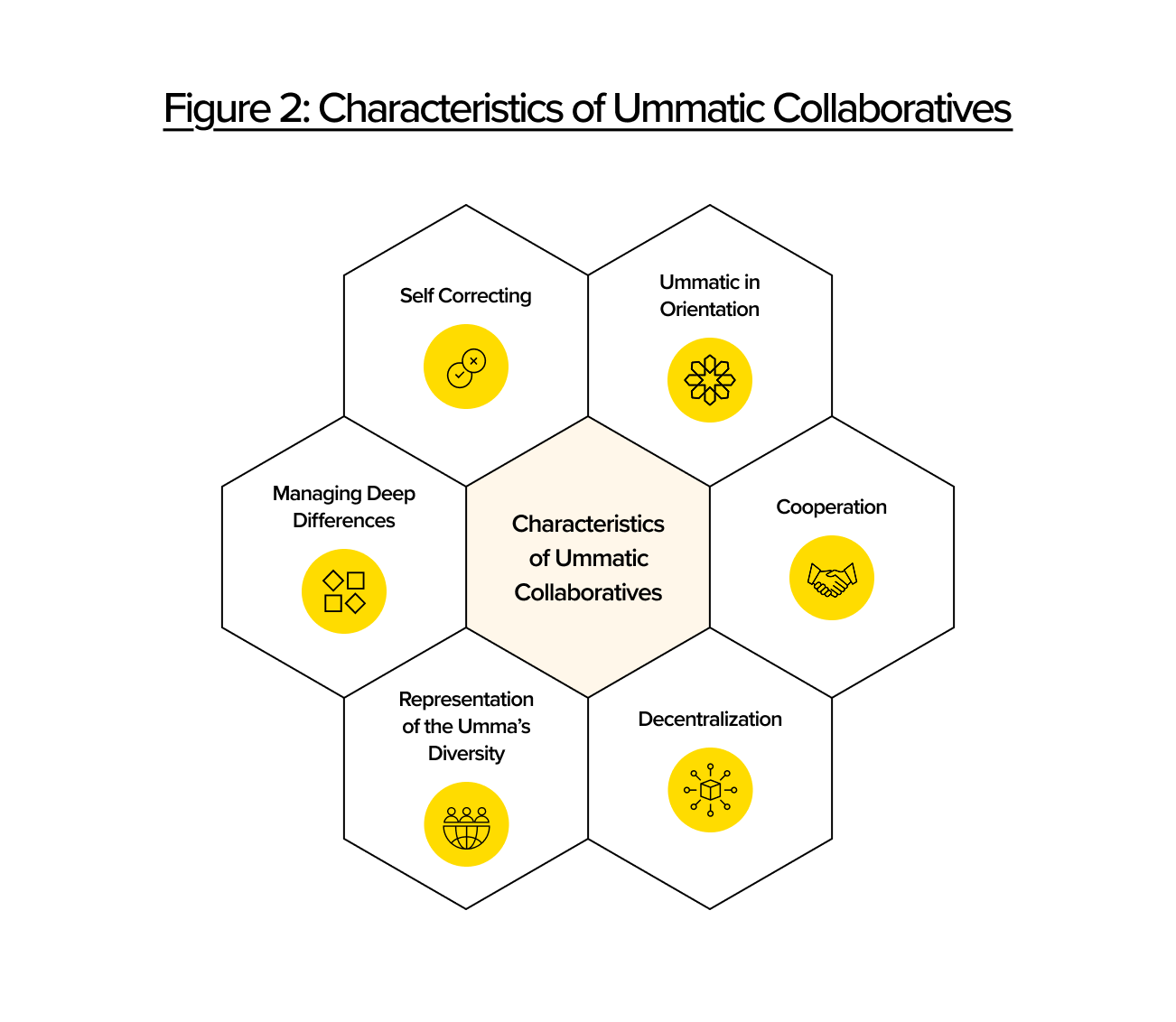
There are, of course, better and worse modes of operation for any collaborative work. I propose that ummatic collaboratives ought to be grounded upon six foundational criteria:7
- Ummatic orientation
- Cooperation
- Decentralization
- Representation of the Umma’s diversity
- Successfully managing differences
- Self-correcting
The rest of this paper will elaborate on each of these criteria, theoretically grounding them, as well as offering concrete recommendations and strategies for how they can be operationalized. It will conclude by calling for the establishment of a ratings organization to audit and ensure the transparency and accountability of these collaboratives.
1. Ummatic Orientation
Our first anchoring principle calls for collaboratives to be ummatic in orientation. Such an orientation grounds the initiative in sincere obedience to Allah rather than social or political expediency. This is perhaps the most critical, overarching premise of the entire collaboratives’ initiative. It is a commitment to serving the interests of the global Umma—specifically, its independence, integration, security and influence8—rooted in Islamic tradition and ethics.
For a collaborative to be ummatic in orientation at a more dunyawī or practical level means that it views its work and allegiances through the lens of the global Muslim Umma rather than through narrow sectarian or ethnic boundaries.9 It entails cultivating a sense of solidarity, shared purpose, and moral commitment to the collective well-being of Muslims globally. This would enable the Umma to serve as the locus of a flourishing Islamic civilization, in turn serving humanity as well.
This orientation involves several key features. First, it entails a deeply internalized sense of concern for the whole Umma. An ummatic collaborative sees the suffering, struggles, and aspirations of Muslims in different regions—whether in Gaza, Kashmir, or East Turkestan—not as foreign issues but as internal matters of deep personal and collective concern.
Second, an ummatic orientation means transcending nation-state logic. As Wael Hallaq has pointed out, “Whereas the nation-state is the end of all ends, knows only itself, and therefore is metaphysically the ultimate foundation of sovereign will, the Community (Umma) and its individual members are a means to a greater end.”10 The nation-state is undoubtedly one of the biggest obstacles to ummatic unity.11 Rather than prioritizing the interests of one’s own nation-state or ethnic group, an ummatic collaborative questions the legitimacy of artificial divisions imposed by colonial borders and nationalistic ideologies. It seeks forms of cooperation and integration among Muslim societies that are politically feasible and normatively desirable within an Islamic framework.
Third, this orientation means having institutional vision and civilizational aspirations. Being ummatic involves the practical effort to build institutions—educational, economic, media, political—that serve the Umma and humanity as a whole and aim toward civilizational renewal. Having an ummatic orientation “neither negates nor precludes conventional politics, it only orders and redirects it, in the same way that the Islamic notion of marriage does not negate the customary, local, and cultural notions of marriage, but rather gives it particular form and purpose.”12
Finally, an ummatic orientation necessitates intellectual and discursive responsibility. It also implies a refusal to be intellectually provincial. It calls for producing and engaging with knowledge that is globally relevant, informed by Islamic sources but conversant with contemporary debates, and that speaks to the challenges facing Muslims worldwide. Indeed, as Anjum points out, “Ummatic universalism need not be a zero-sum game vis-a-vis local and particularist affiliations; Islam celebrates some kinds of difference, mitigates other kinds, and discourages and prohibits yet other kinds.”13 In short, for an ummatic collaborative to be ummatic in orientation means that it operates on the assumption that the umma is real, not just a theological concept but a concrete moral and political project worthy of realization.
1.1 Principles and Values
- Solidarity beyond Boundaries: Cultivate deep concern for the global Umma, recognizing the struggles of Muslims everywhere as shared responsibilities. This requires rejecting narrow sectarian, ethnic, or national loyalties and affirming a sense of collective moral duty.
- Transcend Nation-State Logic: prioritize the unity, security, and integration of the Umma over nation-state expediencies. Encourage forms of political cooperation that remain faithful to Islamic principles while remaining practically feasible.
- Civilizational Vision and Responsibility: Build institutions, networks, and knowledge systems that serve the entire Umma. This involves advancing education, economics, media, and governance in ways aligned with Islamic tradition, while also engaging global debates with intellectual seriousness and moral clarity.
1.2 Structure and Processes
- Include a body of Islamic scholars: A council of scholars must be constitutive to any ummatic collaborative, anchoring every endeavor in Islamic normative frameworks and directing the initiative with an unwavering ethical compass. Such oversight also mitigates the possibility of ideological distortion and external capture. To prevent centralized “rubber-stamping” while preserving decentralization, each collaborative should pair its internal scholarly advisors with an external, unpaid “request-for-comments” round drawn from a broad, rotating pool of scholars. The activities of these unpaid external scholars would be time-bound and require a disclosure of prior ties in order to minimize conflicts of interest and concentrated gatekeeping. All external comments, whether accepted or rejected, should be archived and circulated to members with brief reasons for disposition. This would help institutionalize transparency without subordinating scholarly independence.
- Craft anchor mission statements and principles rooted in Islamic sources: Anchoring an ummatic collaborative’s mission and guiding principles in Islamic sources is essential. Such grounding ensures that the initiative develops a genuinely ummatic character. Collaboratives should clearly articulate their core principles within the broader Islamic tradition, thereby setting normative boundaries and affirming their legitimacy.
- Adopt screening mechanisms for participants’ ummatic alignment: Collaboratives should use balanced screening and alignment processes to keep participants focused on overarching ummatic aims. If standards are too strict, they needlessly exclude people and stifle creativity; if too lax, they invite inactivity or, even worse, work at cross-purposes. The process should prioritize a shared commitment to the ummatic imperatives that ground collective action and exclude actors driven by self-aggrandizement or sectarian agendas. In this way, the collaborative preserves internal coherence and principled direction without becoming unduly restrictive.
2. Cooperation
For ummatic collaboratives to effectively fulfill their mission, cooperation must be an institutional imperative. This entails a principled commitment to working across national and ideological boundaries in pursuit of shared ummatic goals. The Qurʾān emphasizes mutual collaboration as an obligation upon all Muslims: “Cooperate with one another in righteousness and piety, and do not cooperate in sin and aggression.”14 Ummatic collaboratives, therefore, must view cooperation as the engine of integration; an essential tool for overcoming division and establishing harmonious action among diverse Muslim communities.
From a strategic and structural perspective, the importance of cooperation cannot be overstated. The fragmentation of the Umma is one of its greatest challenges, as numerous uncoordinated efforts often duplicate work and waste resources. In a world where the latent capacity of the Umma is immense, cooperation enables resource pooling, knowledge sharing, and collective agenda-setting. A decentralized but cooperative approach allows diverse groups within the Umma to align their efforts in pursuit of shared goals, leading to a more effective use of resources and a stronger collective voice.
In practical and political terms, cooperation between various sectors and actors significantly enhances a collaborative’s soft power. Soft power, by its nature, is not an isolated effect but a cumulative force that arises when various actors and sectors act in concert. For instance, a media collaborative supporting a boycott campaign can work in tandem with a legal collaborative that documents corporate complicity, ensuring that the narratives are aligned. This synchronized approach creates a much stronger, unified influence than would not be possible if each sector operated independently. Thus, cooperation not only amplifies the reach and effectiveness of individual initiatives but also contributes to broad-based and sustainable soft power networks.
Moreover, cooperative networks exhibit significant resilience against external pressures such as censorship, repression, or donor conditionality. In situations where one node or member of the network faces external challenges or risks compromising its position, other parts of the network can share burdens and continue the work that needs to be done. The sustainability of ummatic networks is thus inherently tied to their ability to cooperate; their collective strength lies in their shared knowledge.
Finally, from a civilizational perspective, ummatic collaboratives are enactments of the Umma’s future. Cooperation within these institutions model the vision of the Umma that Islam calls for: a community that transcends fragmentation towards political, economic and civilizational unity.
2.1 Principles and Values
- Non-exclusive mentality: Collaborative participants must avoid a “saved sect” mentality and collaboratives should urge its members to work with multiple efforts simultaneously. Collaboratives should regularly and publicly praise and uplift all worthy efforts. This should naturally result in prevention of sectarian debates and disparagement of other efforts. This approach should recognize the benefit of redundancy of efforts (another collaborative doing similar work) as long as the collaborative spirit is not compromised.
- Openness to share: This is manifested in transparency and openness to sharing of best practices with other efforts—contrary to the capitalist emphasis on intellectual property ownership and competition.
- Importance of specialization for efficacy of work: Collaboratives should have a specified scope of work. This can be based on field or region. A targeted scope of work or geography tends to increase efficacy.
- Invitations for constructive criticism: Having a culture of openness to constructive feedback will increase structural resiliency in the face of internal and external disputes.
2.2 Structure & Processes
- Development of interoperable protocols for work with other collaboratives: Formally or informally recognize other ummatic projects and have pathways for mutual endorsement of outputs and joint trainings to build legitimacy and uptake across regions. Host cross-sectoral retreats or joint strategy sessions. Set up regular coordination meetings to ensure that the protocols are being followed and refined over time. Additionally, implement a feedback system where collaboratives can assess the effectiveness of the protocols and propose improvements. Document these protocols in an accessible, standardized format to ensure that all collaboratives can easily integrate and cooperate without disruptions.
- Meetings and discussion: Host monthly online coordination meetings and annual in-person summits and use structured dialogue techniques (mushāwara, consensus-building) to align goals: Facilitate discussions, allowing for real-time input from all members. Create a pre-meeting agenda and post-meeting reports to keep the discussions focused and ensure an internal collaborative spirit.
- Track the number of multi-collaborative meetings per year: Each collaborative should aim to create and monitor Key Performance Indicators (KPIs) to ensure that cooperation is happening in real time. Examples of KPIs for collaborative could include:
- Number of multi-node projects per year
- Frequency of collaborative meetings
- Community feedback on inclusiveness and mutual support
3. Decentralization
Decentralization is a model in which semi-autonomous nodes operate independently while remaining aligned with shared ummatic principles. Overly centralized networks face several potential operational problems, theoretical (related to legitimacy and worldview) and practical (related to resilience, adaptability, and effectiveness).
When it comes to theoretical problems, overly centralized collaboratives risk co-optation or capture. Centralized bodies have proven time and again to be more vulnerable to being co-opted by political or monied interests, especially when based in or aligned with particular regimes, donors, or elite factions.15 In a centralized system, key decisions, resources, and legitimacy often end up falling under the control of a small group (a central committee or leader).16 This makes the path to influence clearer and narrower: instead of persuading a diverse network, an external actor needs only to capture or influence the center. Once captured, the center can impose decisions downward, reshaping the entire network in alignment with the interests of the co-opting actor. This undermines legitimacy and deters broader participation from independent actors. In addition, centralization often leads to epistemic uniformity, where one interpretive framework or regional perspective dominates while marginalizing others, leading to a reduction of the system’s creative capacity.
With regard to operational and functional problems, centralized networks often become slow, rigid, and hierarchical, hindering responsiveness to emerging crises or opportunities. One only needs to look at the example of the old Soviet Union to see some of the more obvious problems with centralized bureaucracies.17 Overly centralized decision-making bottlenecks reduce the ability to adapt and innovate, especially across diverse regions and sectors.18
Further, centralized systems tend to be less resilient: if the core node fails due to leadership change, scandal, or legal challenges, the entire network is subject to collapse. Decentralized systems, by contrast, can reroute activity and regenerate from peripheral nodes.19 Centralization also often erodes trust and participation and discourages innovation. When power is concentrated at the top, local actors, peripheral regions, or frontline workers feel excluded from meaningful input. Top-down planning often leads to the alienation and resistance of local communities, as their local knowledge and agency are bypassed.20 Innovation flourishes best in semi-autonomous, cross-pollinating environments.
In addition, decentralization foregrounds non-state actors (e.g. GEMs21: Globally Empowered Muslims such as scholars, entrepreneurs, educators) as legitimate agents of influence. Ummatic soft power must be wielded by those individuals who see themselves as trustees (amāna-holders) of the Umma’s internal strength, whose loyalty lies not with parochial elite cliques but with the civilizational mission of Islam. These key GEMs are geographically dispersed. In order to harness their collective abilities, decentralization becomes a required characteristic to ensure Umma-wide participation.
Finally, it is important that one does not conflate decentralization with disorganization. Decentralization ought to be conceptualized not as fragmentation but rather as coherent diversity: nodes within each ummatic collaborative ought to contribute locally and draw from the Umma globally. This requires careful balancing: it requires both unity of purpose (moral clarity, ummatic orientation) and autonomy of practice (local knowledge, sectoral expertise). Ultimately, decentralization enables ummatic collaboratives to act globally with integrity, agility, and resilience, shaped not by top-down command but by collective trust, moral vision, and shared responsibility.
3.1 Principles and Values
- Prioritizing the Umma over institutional prestige: Decentralization requires that the collective good of the Umma remains the overriding priority, even above the prestige or survival of any particular organization. When organizations see themselves as instruments of a higher ummatic mission, they are less likely to hoard resources or obstruct new initiatives out of fear of losing relevance. This principle cultivates humility and trust, ensuring that collaboratives are evaluated (and self-evaluated) by their contribution to ummatic empowerment rather than by their institutional brand.
- Prioritize GEMs as core building blocks of collaboratives: Globally Empowered Muslims (GEMs) bring the expertise, networks, and credibility needed for collaboratives to thrive. Their participation ensures that leadership and innovation do not concentrate in a single hub but are distributed across the Umma. By prioritizing GEM involvement regardless of geography, ethnicity or nationality, collaboratives ensure global representation, unlock diverse skill sets, and avoid privileging elite centers at the expense of peripheral but equally valuable voices.
- Legitimizing strategic diversity: In a decentralized system, strategic divergence is not a weakness but an expected and even healthy feature of a plural ummatic ecosystem. Different organizations may pursue varied methods to achieve overlapping goals, and these variations should be recognized as legitimate differences of opinion (assuming they fall within the acceptable bounds)22 rather than as grounds for division. The key is to foster collaboration where strategies align, while respecting divergence where they do not, thereby preventing competition from undermining the broader ummatic project.
3.2. Structure and Process
- Distribute leadership and responsibilities across multiple regional nodes: While regional focus is an acceptable operative norm (e.g. a Southeast Asia focused collaborative that is largely Southeast Asia-based), pathways should exist that allow for the incorporation of a global specialists-oriented collaborative where competence adds value. It is important to avoid central hubs that have exclusive and persistent control over the delegation and management of deliverables. Implement mechanisms to find and elevate competency wherever it is. In order to encourage collaboration across nodes, consider designating cross-node teams for larger initiatives that require wide-ranging input.
- Create a flat structure where the collaborative leader’s primary function is to facilitate decision making by core members. The role is to keep deliberations open, maintain order in discussions, and guide members toward consensus. Authority rests with the collective, while the leader ensures that processes remain consultative rather than hierarchical. Recall that the collaborative itself is not an implementing body (such as a project or company) but a forum for shaping a shared roadmap and creating the environment in which projects can align with it or arise from it. Its central function is consensus-building, not execution, and this is best preserved through a facilitative rather than directive role.
- Operationalize the opportunity for “spin offs with collaboration” rather than frown on “splintering” of the organization. Establish a formal framework that encourages autonomy within the collaborative network while maintaining aligned goals. Develop clear guidelines for spin-offs, ensuring they remain connected to the larger mission but are empowered to evolve independently. Create mentorship structures where spin-offs receive support and resources during their early stages, while still benefiting from shared infrastructure, such as funding channels, knowledge exchanges, and cross-network collaborations. Finally, hold regular joint meetings to foster collaboration, ensuring spin-offs and the original collaborative can share insights, leverage synergies, and avoid redundancy.
4. Representation of the Umma’s Interests
Representation is the structuring of a collaborative so that it embodies the interests of the Umma across regions and fields. These interests are increased levels of ummatic integration, independence, and security, which together allow it to shape global discourse and serve humanity. To uphold them, the collaborative must take the Umma as a whole as its frame of reference.
The challenges and opportunities faced by Muslims in different regions of the world vary greatly. By incorporating localized knowledge and expertise, ummatic collaboratives can create approaches that are grounded in real conditions rather than abstract, one-size-fits-all theories. Elinor Ostrom’s pioneering research on polycentric systems convincingly shows that decentralization leads to more effective outcomes when dealing with complex, variable conditions, precisely because such systems can draw upon distributed insight from various actors.23 This makes the collaborative more adaptable and responsive to the unique challenges faced in different contexts.
Further, incorporating broad participation from multiple constituencies not only enhances trust and legitimacy but also ensures that the collaborative is viewed as inclusive and representative of the diverse Umma. If a collaborative were to be dominated by one region or group, it would risk being seen as serving narrow interests, which could undermine its moral and political legitimacy. When Muslims from different backgrounds see themselves represented within a collaborative, it strengthens the trust, support, and energy required for the initiative’s success.24
Another strategic benefit of a diverse collaborative is the multiplication of soft power channels. Each participant, whether a Turkish media producer, Senegalese scholar, or Malaysian tech activist, brings their own set of networks and audiences. This amplifies the reach of the collaborative and creates multiple avenues through which Islamic values and narratives can be projected globally, reinforcing the collaborative’s ability to exert influence and soft power on a worldwide scale. In this way, diversity is not merely a structural feature but a strategic asset that enhances the collaborative’s effectiveness and visibility.
Finally, theologically and politically, the importance of diversity in a collaborative can be framed as part of the broader vision of reclaiming the civilizational unity of the Umma. The fragmentation of the Umma by nation-states, colonial legacies, and sectarian divides is a historical imposition.25 A representative collaborative is more than just a functional mechanism; it is a symbolic reversal of disunity. By demonstrating that Muslims can work together across borders while still preserving their legitimate diversity, the collaborative embodies a tawḥīdic integration; a unity that arises from shared purpose, not imposed sameness. This is not unity through uniformity but unity through mutual respect for diversity, grounded in the belief that the strength of the Umma lies in its diversity as long as it works toward collective good.
4.1 Principles & Values
- Representation as a theological and ethical obligation: The Qur’an describes the Umma as a single brotherhood (49:10), and the Prophet e likened it to a body in which each part responds to the pain of the other. Representation is a religious duty grounded in these teachings. A collaborative that claims to be ummatic must reflect this principle by giving weight to the concerns of the whole body, not only parts of it.
- Representation as the foundation of legitimacy: The authority of an ummatic collaborative depends on whether it embodies the Umma’s collective identity. Without broad representation (based on the intended scope, see 2.1 below), it becomes a factional effort and cannot claim ummatic legitimacy. Representation is therefore the ground upon which the collaborative’s moral and political standing rests.
4.2 Structure and Process
- Representation within a defined scope: For a collaborative to be effective, its representation must operate within a defined scope. Scope determines the boundaries of who and what is to be represented. If the scope is regional, the collaborative must ensure representation of the different voices within that region. If the scope is tied to a domain of soft power, such as law or technology, it must include the range of actors within that field. Without scope, representation risks being diffuse and symbolic; with a clearly defined scope, it becomes concrete and actionable.
- Representation must transcend inherited fault lines: As collaboratives define their scope, they must avoid reproducing the divisions that have historically fragmented the Umma. The borders of nation-states, categories of ethnicity, or sectarian alignments cannot be the organizing principle of representation. These boundaries reduce the Umma to factions and undermine its collective voice. True representation requires that collaboratives draw across these divides, ensuring that the scope reflects the Umma’s unity rather than its fragmentations. A practical way that regional collaboratives can satisfy this requirement is by broadening scope to a region rather than nation-state boundaries.
- Representative feedback mechanisms for goal setting and planning processes: Establish regular feedback mechanisms through surveys, focus groups, or online consultations involving a broad range of stakeholders. These mechanisms should allow participants from diverse backgrounds to provide input on strategic priorities and challenges. Use the appropriate tools to analyze feedback, identifying key themes and areas of concern. Ensure that feedback is systematically integrated into the decision-making process by sharing the findings with team members and adjusting plans accordingly. This helps maintain alignment with the needs and expectations of the umma while fostering collaborative ownership of the goals.
5. Managing Differences
The downfall of nations has often followed from internal strife, and Islamic history demonstrates how unresolved divisions can weakened the Umma at critical junctures. Strength and integration require that such differences be managed fairly rather than ignored or suppressed. Deep differences, by their nature, resist easy resolution, yet within Islam they can be engaged on the basis of shared norms of belief and practice on the one hand, and the use of innovative structures and processes on the other.
It is critically important for ummatic collaboratives to learn to manage differences because the success of any ummatic initiative depends on transforming diversity into strength rather than letting it become a source of fragmentation. This approach is not simply a superficial call for unity but an absolute necessity, grounded in Islamic tradition and practical reality.
First, there is a theological and ethical imperative to consider. As the Qurʾān states, “Had your Lord willed, He would have made all of humanity one community.”26 Islam does not equate unity with sameness; rather, it calls for a unity of purpose amidst diversity. The Prophet e and early scholars modeled pluralism within orthodoxy, valuing disagreement within ethical bounds. Islamic tradition has developed rich norms for handling disagreement with respect, humility, and mutual consultation.27
Beyond theological and ethical considerations, there are strategic and operational necessities that further reinforce the need for managing differences. If differences are left unmanaged, they may lead to undermining trust and the disenfranchisement or marginalization of valuable members within the collaborative. In their seminal work that explores the dynamics of collaborative governance, Chris Ansell and Allison Gash emphasized that effective collaboration requires more than just bringing diverse stakeholders together. They argue that without careful management of differences through mechanisms such as face-to-face dialogue, trust-building, and shared understanding, collaborative efforts can become mired in conflict and inefficiency. The “collaborative process is not merely about negotiation but also about building trust among stakeholders.”28
Managing differences within a collaborative is also necessary to protect against external exploitation. History has shown that rival actors have often exploited internal divisions to weaken the Muslim community.29 The divide-and-rule tactics of such actors can destabilize initiatives and co-opt vulnerable groups. By proactively managing differences, a collaborative can fortify the collective against these external pressures, ensuring that it remains resilient and united in the face of challenges. This is particularly important when elite capture or external manipulation might threaten the collaborative’s mission and vision for the Umma.
Managing differences is not simply a matter of politeness or tolerance but is the precondition for any lasting and spiritually authentic ummatic project. The Prophet e provided a model for how to lead a diverse yet unified community, bringing together various tribes and personalities under a unifying moral vision, while not erasing differences.
5.1 Principles and Values
- Affirm mutual recognition and respect as a theological and communal imperative: The Qurʾan and Sunna affirm that difference within the bounds of faith is to be tolerated. The Islamic tradition also cautioned against excommunication and coercion, recognizing that unity requires restraint. For those engaged in collective work, this principle means that participants must accept coexistence across deep differences and practice reciprocity: granting others the same space to seek and live divine truth that they seek for themselves.
- Anchor engagement in the most broadly shared Islamic norms: Engagement across difference must be anchored in the most broadly shared foundations of Islam: īmān in Allah, in the Prophet e and the Qurʾan, and the obligations of worship and da’wa. These universal commitments provide the ground on which mutual recognition and respect is possible and on which dialogue can take place without dissolving the unity of the Umma. Collaboratives should make these universals the basis for inclusion while allowing parochial identities, such as schools of law or theological traditions, to exist without letting them define the whole. Each collaborative should record its own delineation of these shared norms, with the understanding that definitions may vary across contexts while remaining anchored in the essentials of the dīn.
- Commit to inclusivity as a condition of managing differences: A collaborative that manages differences well must remain inclusive of all who affirm Islam’s shared norms. Excluding voices within these bounds undermines legitimacy and weakens the possibility of meaningful dialogue. Representation of difference, within the framework of shared faith, is therefore a principle of management.
5.2 Structure and Processes
- Establish written rules of engagement that minimize exclusion: Collaboratives should adopt written guidelines that make explicit what forms of exclusion are inadmissible. This includes a ban on takfīr or questioning the legitimacy of participants who affirm Islam’s shared norms, as well as dismissing contributions based on ethnicity, nationality, or sectarian identity. An opt-in strategy allows participants to disengage from areas where they differ while still contributing where agreement exists. A simple mechanism should be in place for members to raise concerns if these rules are violated, with facilitators empowered to intervene quickly.
- Train facilitators and design dialogue formats to manage conflict: Collaboratives should not leave discussion dynamics to chance. Facilitators and those in leadership roles should be trained in conflict management and equipped with tools for de-escalation, mediation, and constructive dialogue. Meetings should be structured to identify points of convergence, clarify disagreements without inflaming them, and keep discussions tied to shared objectives. Written summaries of outcomes and agreed follow-ups can further prevent disputes from festering.
- Implement practices that build organizational trust: Trust arises from consistent behaviors that demonstrate integrity, clarity, and respect. Organizational studies highlight transparency, psychological safety, and follow-through on commitments as the foundation of trust (Harvard Business Review, The 3 Elements of Trust, 2019). In collaboratives, this means sharing decisions openly, inviting and acting upon feedback, holding difficult conversations with honesty, and creating spaces where members feel safe to express disagreement. Over time, these steady practices sustain dialogue across deep differences.
- Adopt criteria that align projects with the Umma’s agreed interests: Collaboratives should direct their work toward the agreed interests of the Umma—integration, independence, security, and influence. Projects selected for support must be clearly aligned with these interests and should be those that enjoy the broadest acceptance among participants. By grounding their agenda in the Umma’s agreed interests and widely supported initiatives, collaboratives maintain unity of purpose and legitimacy in the eyes of the community.
- Differentiate the role of collaboratives from the work of projects: Collaboratives are not designed to subsume or direct the work of existing projects and initiatives. They function as connective spaces where individuals, already engaged in their own efforts, align those efforts within a wider ummatic framework. Differences of opinion on matters beyond the shared norms will often manifest in the projects themselves, since a decentralized network allows for varied approaches. This should be accepted as a natural feature of ummatic work. The task of the collaborative is to sustain unity at the level of shared commitments and interests while allowing projects to pursue their distinct paths.
6. Self-Correction
Self-correcting mechanisms ensure that a collaborative can remain true to its goals, uphold its moral and ethical integrity, and adapt to changing circumstances or challenges without losing direction. The importance of self-correction is rooted in both Islamic ethical principles and operational necessity.
From an ethical standpoint, the concept of accountability (ḥisba) is deeply embedded in Islamic governance, emphasizing that every member of the Umma is responsible for the collective good.30 A collaborative must embrace self-correction as a means of preserving its integrity and avoiding mission drift. External pressures, such as political influences or donor interests can easily cause a collaborative to stray from its foundational Islamic principles if not managed carefully. Self-correction allows the collaborative to navigate these pressures without becoming vulnerable to co-optation by political, economic, or ideological forces, thus preserving its legitimacy and maintaining trust among its stakeholders.
Additionally, Islamic governance encourages the principles of shūrā and nasīḥa which require institutions to reflect constantly on their actions and remain open to change.31 This ensures that leadership power does not concentrate unchecked, and the institution remains responsive to the collective needs of the Umma. The prophetic model of leadership, which emphasizes humility, accountability, and periodic review, provides a critical framework for collaboratives to adopt as they evolve.
From an operational perspective, the global context in which collaboratives operate is constantly shifting politically, socially, economically, and technologically. A self-correcting and self-critical system enables a collaborative to adapt and evolve in response to these dynamic conditions. Without such mechanisms, collaboratives might continue to implement ineffective practices or outdated strategies, leading to stagnation or irrelevance in addressing the evolving needs of the Umma. Self-correction also improves decision-making by fostering feedback loops that help identify weaknesses and ensure that actions are aligned with the collaborative’s goals. Whether through consultation, reflection, or feedback from stakeholders, these mechanisms provide real-time data, enabling rapid course adjustments. This flexibility makes the collaborative more responsive to emerging opportunities and crises, ensuring that it remains relevant and effective.
A self-correcting collaborative also contributes to building trust and legitimacy. By maintaining transparency and accountability, it fosters a culture where members and stakeholders feel that their concerns are heard and their contributions are integrated into future plans. This inclusive environment helps to create a trust-building foundation, ensuring that divergent views are respected and that stakeholders feel their participation shapes the direction of the collaborative. Furthermore, without self-correction, dissatisfaction can fester, potentially leading to fragmentation, disengagement, or even the departure of key actors. To prevent such outcomes, a self-correcting collaborative actively addresses concerns and conflicts before they escalate into systemic issues. Maintaining open channels for feedback and conflict resolution ensures that differences can be navigated with care, preserving unity and cooperation.
6.1 Principles and Values
- Affirm accountability as an obligation: Accountability is not optional but a duty. Every collaborative must recognize that being held to account is part of serving the Umma and sustaining trust.
- Practice correction as humility and worship: Correction is not only organizational maintenance but an act of humility before Allah. To receive criticism, admit error, and make changes in service of the Umma is an act of worship, reflecting the prophetic call to sincerity.
- Make self-correction a collective responsibility: Excellence (iḥsān) requires that correction not be left to leaders or committees alone. Every member has a duty to contribute to identifying shortcomings and to ensuring that the work meets the highest standards.
- Evaluate all activities by the Umma’s agreed interests: Self-correction must be guided by the agreed interests of the Umma: integration, independence, security, and influence. If the work of a collaborative does not advance these, or if they begin to diminish, it is a sign that the path has moved off track.
6.2 Structures and Processes
- Set a north star and track outcomes transparently: Each collaborative should adopt a clear north-star statement at the start of the year, reviewed mid-year, and link it to a concise set of KPIs tied to the Umma’s agreed interests. Progress should be published through a public dashboard updated regularly, alongside a narrative scorecard that records achievements, shortfalls, and corrective actions.
- Institutionalize ethical audits and peer review: Collaboratives should regularly require member self-assessments against predefined ethical principles, followed by peer review. An oversight body should compile findings, recommend corrective measures, and publish reports to members. Auditors and review teams should rotate to prevent capture, and conflict-of-interest rules should be enforced to maintain integrity.
- Ensure funding transparency and guard against undue influence: Each ummatic collaborative should establish a public disclosure policy requiring full transparency on funding sources. Regular audits must be conducted to assess the potential influence of donors on the collaborative’s mission or decisions. These disclosures should be shared on an accessible digital platform, fostering accountability and protecting the integrity of the collaborative from undue external influence.
- Create mechanisms for escalation and independent oversight: Collaboratives should maintain protected channels for raising concerns, including confidential intake and guarantees against retaliation. In addition, periodic external reviews by independent experts should assess the collaborative’s strategy, governance, and Findings and responses should be shared publicly to reinforce accountability.
Conclusion: On the Need for an Independent Collaborative Ratings Organization
This paper argues that ummatic collaboratives are a key vehicle for translating the latent soft power of the Umma into coordinated, civilizational action. Drawing on the TAN literature, collaboratives are framed as decentralized yet value-driven networks that connect public sentiment with centres of power. The core functions through which they set direction, convene key actors, and align projects with both near-term and long-term ummatic goals are also outlined. The paper has also proposed six foundational criteria for their healthy operation—ummatic orientation, cooperation, decentralization, representative breadth, effective management of differences, and robust self-correction—together with concrete structures and processes through which these can be operationalized and institutionalized.
Yet precisely because collaboratives are meant to be morally anchored, decentralized, and influential, they are also vulnerable to drift, capture, and opacity if left entirely to self-regulation. It is therefore not enough to describe what good collaboratives should look like; there must also be an independent mechanism that can assess, benchmark, and publicly signal whether these standards are in fact being met. For this reason, in concluding this paper, the establishment of an independent collaborative ratings organization to review and audit ummatic collaboratives is proposed as a necessary institutional complement to this framework.
Such an independent body is crucial for ensuring transparency, accountability, and the effective functioning of the broader ummatic network. In an era where many ummatic initiatives operate across diverse geographies and sectors, there is a growing need for a body that can objectively assess the impact and operational transparency of these collaboratives. This independent organization would ensure that the principles of integrity, justice, and mutual benefit are upheld across all ummatic projects, facilitating trust among the community and ensuring that resources are effectively used for the collective good.
The primary function of such an organization would be to set clear and universally accepted standards for ummatic collaboratives. It could include measures of financial transparency, social impact, adherence to Islamic principles, and operational efficiency. The ratings system could operate similarly to well-established organizational reviews, providing a comprehensive assessment based on a set of criteria developed collaboratively with various stakeholders from across the Umma. This would: 1) enhance the credibility of ummatic initiatives; 2) help identify areas for improvement; 3) encourage innovation, and 4) ensure that the initiatives are aligned with the values and goals of the broader Umma.
To implement this, the ratings organization should be independent, impartial, and equipped with the expertise to review complex different projects within an Islamic framework. The creation of an expert committee composed of experts and specialists across various fields would be vital in ensuring the reliability and integrity of the assessments. The collaborative audits should be designed to be both formative and summative, providing constructive feedback while also enabling the public to make informed decisions about which initiatives best align with their values and goals. Such reviews would help prevent the co-optation of ummatic projects by external interests and ensure their sustainability in the long term.
In practice, the organization could conduct regular audits and publish annual reports on its findings, similar to the auditing processes in corporate and non-profit sectors. These reports could be made available to the public, ensuring transparency and providing a measure for ummatic collaboratives to strive towards excellence. Additionally, the independent collaboratives rating organization could offer support to collaboratives that are struggling to meet established standards, providing them with the tools, resources, and guidance needed to improve. By establishing such an independent body, the Umma can enhance its collective capacity. This will ensure that its efforts are directed towards positive social change and fortify the bonds of trust that hold the community together.
* * *
Suggested Citation:
Joseph J Kaminski, “Operationalizing Ummatic Soft Power: Criteria for Effective Collaboratives,” Ummatics, Nov 19, 2025, http://ummatics.org/collaboratives.

Joseph Kaminski
Joseph J. Kaminski, Ph.D., holds the rank of Professor and is affiliated with the Department of Political Science and International Relations at the International University of Sarajevo. He received his B.A. in Political Science and Philosophy (double major) from Rutgers University (2004), M.A. in Political Science from the City University of New York (CUNY) – Graduate Center (2008), and Ph.D. in Political Science from Purdue University (2014). His current research interests include religion and politics/international relations with a focus on the Muslim world, comparative political theory, and new approaches to Islam and public reason. His works have appeared in The Journal of Politics, PS: Political Science and Politics, Social Compass, Religious Studies Review, and The Thunderbird International Business Review. He also has written two solo-authored manuscripts: The Contemporary Islamic Governed State: A Reconceptualization (Palgrave, 2017) and Islam, Liberalism, and Ontology: A Critical Re-evaluation (Routledge, 2021). He has been a Research Associate at the Ummatics Institute since May 2022.
Notes
- Joseph S. Nye, Jr., “Public Diplomacy and Soft Power,” Annals of the American Academy of Political and Social Science 616, no. 1 (2008): 94.
- Ashraf Motiwala, “Ummatic Soft Power as a Catalyst for Change,” Ummatics, May 21, 2025, https://ummatics.org/soft-power/, 8–9.
- Margaret E. Keck and Kathryn Sikkink, Activists Beyond Borders: Advocacy Networks in International Politics. (Ithaca, NY: Cornell University Press, 1998); Sidney Tarrow, The New Transnational Activism (Cambridge: Cambridge University Press, 2005).
- Keck and Sikkink, Activists Beyond Borders, 48.
- Motiwala, “Ummatic Soft Power,” 7.
- For more on the boomerang pattern, see Keck and Sikkink, Activists Beyond Borders, 12–13.
- Not all Islamic efforts need to be ummatic and adopt these six characteristics. This paper aims to theorize the characteristics required for a specific structure with a specific aim: building an Umma that is integrated, independent, secure, and capable of calling humanity to Islam.
- A forthcoming paper by Ummatics Institute will explore the four dimensions of independence, integration, security, and influence in greater depth, providing a comprehensive framework for understanding their role in advancing the interests of the global Umma.
- For more on what it means to be ummatic, see Ovamir Anjum, “What is Ummatics?,” Ummatics, March 9, 2023, https://ummatics.org/papers/secular-integration-models-and-global-governance-schemes-lessons-for-ummatic-integration
- Wael Hallaq, The Impossible State: Islam, Politics, and Modernity’s Moral Predicament (New York: Columbia University Press, 2013), 49.
- Joseph J. Kaminski, “Irredeemable Failure: The Nation-State as a Nullifier of Ummatic Unity,” Ummatics, December 14, 2022, https://ummatics.org/irredeemable-failure-the-modern-nation-state-as-a-nullifier-of-ummatic-unity/
- Anjum, “What is Ummatics?”, 5.
- Anjum, “What is Ummatics?”, 5.
- Qurʾan, 5:2.
- See David Harvey, A Brief History of Neoliberalism (New York: Oxford University Press, 2005); Arjun Appadurai, Grassroots Globalization and the Research Imagination (Durham: Duke University Press, 2000).
- The tendency being discussed is often referred to as “the iron law of oligarchy” which suggests that the structures and dynamics of large-scale organizations, especially those with centralized authority and professional bureaucracies, tend to favor the rise of an oligarchic leadership, even if the organization initially aims for democracy. See Robert Michels, Political Parties: A Sociological Study of the Oligarchical Tendencies of Modern Democracy (New York: Routledge, 1999 [1911]).
- For more on the inefficiency of centralized Soviet bureaucracy, see Alec Nove, The Economics of Feasible Socialism (New York: Routledge, 1983); János Kornai, The Socialist System: The Political Economy of Communism (Princeton: Princeton University Press, 1992)
- See Joseph Berliner, The Innovation Decision in Soviet Industry (Cambridge, MA: M.I.T. Press, 1976).
- See Manuel Castells, The Rise of the Network Society (Oxford: Blackwell Publishers Ltd., 1996); Elinor Ostrom, Governing the Commons (Cambridge: Cambridge University Press, 1990).
- See James C. Scott, Seeing Like a State How Certain Schemes to Improve the Human Condition Have Failed (New Haven: Yale University Press, 1998).
- Globally Empowered Muslims (GEMs) refers to individuals who are: (a) globally connected through education, technology, and professional networks; (b) actively engaged in using their skills, knowledge, and influence to positively impact the Umma in ways that transcends nation-state boundaries and divisions; and (c) with a focus on unity, renewal, and ethical action grounded in Islamic norms and principles.
- For a robust treatment of the topic of acceptable bounds of differences of opinion in Islamic law, see Nazir Khan, “Difference of Opinion: Where Do We Draw the Line?,” Yaqeen Institute, Dec 10, 2019, https://yaqeeninstitute.org/read/paper/difference-of-opinion-where-do-we-draw-the-line.
- See Ostrom, Governing the Commons, 90–105.
- Igor Linkov, Benjamin Trump, and Greg Kiker, “Diversity and inclusiveness are necessary components of resilient international teams,” Humanities and Social Sciences Communications 9, no. 1 (2022): 115.
- For more on this topic, see Jonathan Laurence, Coping with Defeat: Sunni Islam, Roman Catholicism, and the Modern State (Princeton, NJ: Princeton University Press, 2021).
- Qurʾan, 11:118.
- See Taha Jabir al-Alwani, The Ethics of Disagreement in Islam. 3rd ed. (Herndon, VA: International Institute of Islamic Thought, 2011); Ahmad al-Raysuni, Al-Shura: The Qur’anic Principle of Consultation, translated by Nancy Roberts (Herndon, VA: International Institute of Islamic Thought, 2011).
- Chris Ansell and Allison Gash, “Collaborative Governance in Theory and Practice,” Journal of Public Administration Research and Theory 18, no. 4 (2008): 559.
- See Hasan Kayali, Arabs and Young Turks: Ottomanism, Arabism, and Islamism in the Ottoman Empire (Berkeley: University of California Press, 1997); Bassam Tibi, Arab Nationalism: Between Islam and the Nation-State (New York: Macmillan, 1997); Shail Mayaram, Resisting Regimes: Myth, Memory, and the Shaping of a Muslim Identity (Oxford: Oxford University Press, 1997).
- See Mohammad Hashim Kamali, Citizenship and Accountability of Government: An Islamic Perspective (Cambridge: Islamic Texts Society, 2011).
- See Joseph J. Kaminski, The Contemporary Islamic Governed State: A Reconceptualization (New York: Palgrave, 2017).